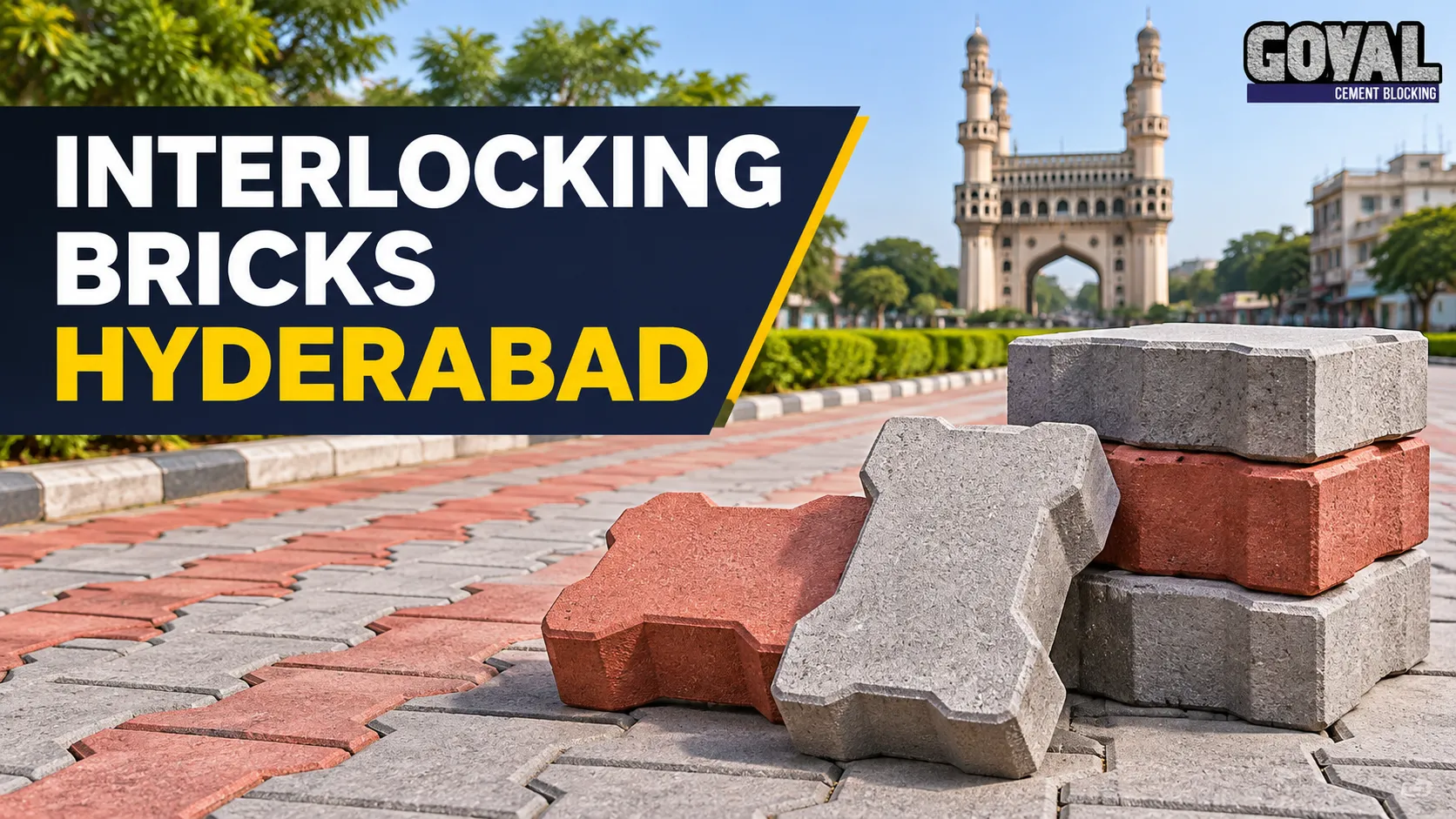
Across Hyderabad's growing outskirts, from Shamshabad and Shankarpally to Medchal, Keesara and Ghatkesar, a lot of new compound walls, farmhouses and independent homes are going up with interlocking bricks instead of conventional brick-and-mortar walls. The reason is simple: interlocking bricks lock into each other, need very little mortar, and can often be left exposed without plastering.
If you are planning to use interlocking bricks in Hyderabad, this guide gives you the practical details you need before you place an order: the current price range, the sizes sold in the city, how they compare with red bricks and solid blocks, where they work best and the mistakes that push up cost. The prices mentioned are ongoing market ranges from Hyderabad and nearby suppliers in late 2026, not a fixed rate card, so always confirm the final quote before you buy.
Interlocking Bricks in Hyderabad: The Basics
An interlocking brick is a pressed masonry unit with raised keys on top and matching grooves underneath. When one course is placed on another, the bricks lock together and resist sliding. Most interlocking bricks also have one or two vertical holes. Once the wall is up, steel bars and concrete grout go into these holes at corners, junctions and openings, turning the wall into a reinforced structure.
You will find three main types of interlocking bricks in Hyderabad:
- Cement concrete interlocking bricks, made from cement, stone dust and aggregate. Grey, dense and strong, they are the most common choice for compound walls and house walls in and around the city.
- Mud or CSEB interlocking bricks, made from soil stabilised with a small share of cement. Their earthy red finish suits farmhouses and eco-style homes.
- Fly ash interlocking bricks, made with fly ash from thermal power plants. They are lighter and are sometimes used for non-load-bearing walls.
For a deeper look at how these units are made and tested, read our Complete Guide to Concrete Interlocking Blocks (2026).
Interlocking Bricks Price in Hyderabad
Interlocking bricks price in Hyderabad is quoted per piece at the factory gate in most cases. Transport, loading and unloading are added on top. Here is the current range you can expect:
| Type | Typical size (L × W × H) | Market price (per piece) |
|---|---|---|
| 6 inch cement interlocking brick | about 12 × 6 × 5 in | ₹31 – ₹40 |
| 8 inch cement interlocking brick | about 12 × 8 × 5 in | ₹36 – ₹50 |
| Mud / CSEB interlocking brick | 6 to 8 inch | ₹40 – ₹50 |
| Small cement interlock brick | 9 × 4 × 3 in | around ₹37 |
What these numbers mean in practice:
- Local listings sit in the middle of the range. A manufacturer in Keesara lists 12 × 8 × 5 inch concrete interlocking bricks for side walls at around ₹36 per piece, and a Hyderabad supplier lists 9 × 4 × 3 inch cement interlock bricks at about ₹37.
- Bigger bricks cost more per piece but fewer are needed. An 8 inch brick covers the same wall face as a 6 inch brick of the same length and height, but gives a thicker, stronger wall.
- Quotes "per sq ft" are usually for construction. When a builder quotes interlocking work per square foot, it normally includes labour and other materials, so compare it with full construction rates, not brick prices.
Hyderabad is generally one of the more cost-friendly metros for masonry materials, because cement and aggregates are available nearby. Even so, transport from the factory to your site can add a noticeable amount, especially for farm plots far from the Outer Ring Road.
Sizes of Interlocking Bricks Sold in Hyderabad
Interlocking bricks do not follow one universal size. Each machine and mould has its own profile, so two "8 inch" bricks from different factories may not fit together. These are the sizes you will most often see in Hyderabad:
- 12 × 8 × 5 inch: the workhorse size for compound walls and outer house walls.
- 12 × 6 × 5 inch: used for inner walls, upper floors and lighter boundary walls.
- Half bricks: used at wall ends, corners and openings so that bricks do not have to be cut.
- U-channel bricks: used to form sill, lintel and roof bands that are later filled with steel and concrete.
Always buy the full quantity for one project from the same supplier and mould, and get the exact dimensions in writing on the quotation.
Where Interlocking Bricks Make Sense in Hyderabad
Interlocking bricks are not the answer for every building. They are strongest where speed, a neat exposed finish and lower plastering cost matter most.
Compound walls for plots and ventures
Hyderabad's open-plot layouts and gated ventures need long boundary walls built quickly. Interlocking bricks go up fast, need little or no plaster and give a clean, uniform face. This is one of the most common uses in the city's outskirts.
Farmhouses and weekend homes
Farmhouses around Shankarpally, Moinabad, Chevella and Medak Road often use exposed interlocking walls for a rustic look. Mud or CSEB bricks are popular here because their colour blends with the landscape.
Independent houses up to G+1 or G+2
With a proper structural design, vertical reinforcement and concrete bands, interlocking bricks can be used for load-bearing walls in small independent houses. For taller buildings, an RCC frame with block infill is the safer, more common approach.
Sheds, godowns and site offices
Warehouses, poultry sheds, workshops and site offices in industrial belts benefit from the speed of interlocking construction and the low finishing cost.
Interlocking Bricks vs Red Bricks vs Solid Blocks in Hyderabad
The real comparison is not price per piece. It is the cost of a finished square foot of wall. Here is a rough guide for 100 sq ft of wall face, using current Hyderabad prices for the walling material only:
| Walling material | Pieces per 100 sq ft (approx.) | Price per piece | Material cost (approx.) |
|---|---|---|---|
| 8 inch interlocking brick (12 × 8 × 5 in) | 240 | ₹36 – ₹50 | ₹8,600 – ₹12,000 |
| Solid concrete block (400 × 200 × 200 mm) | 110 | ₹39 – ₹61 | ₹4,300 – ₹6,700 |
| Red clay brick, 9 inch wall | about 1,000 | ₹9 – ₹12 | ₹9,000 – ₹12,000 |
Reading this table correctly matters:
- Solid blocks are cheapest for the material alone, but the wall still needs mortar joints and plaster on both faces. They are the most practical option for RCC-framed apartments and houses that will be plastered and painted anyway.
- Red bricks cost about the same as interlocking bricks for the material, but need a lot more mortar, more masons' time and full plastering.
- Interlocking bricks save on mortar, plaster, curing water and labour. When the walls stay exposed, the finished wall often ends up competitive with, or cheaper than, a plastered red brick wall.
If your project will be fully plastered, take a look at our cement concrete solid blocks as well.
Worked Example: Compound Wall for a 200 Sq Yard Plot
Many Hyderabad buyers first use interlocking bricks for a compound wall, so here is a simple estimate for a typical 200 sq yard plot (about 30 × 60 ft).
- Wall length. The perimeter is 30 + 60 + 30 + 60 = 180 ft. Leave out a 12 ft gate opening, which gives about 168 ft of wall.
- Wall area. At a height of 6 ft above the plinth, the wall face is 168 × 6 = about 1,008 sq ft.
- Number of bricks. With 12 × 8 × 5 inch bricks at roughly 2.4 per sq ft, you need about 2,420 bricks.
- Add extra. Around 5% for breakage and half-bricks takes it to about 2,540 bricks.
- Brick cost. At ₹36–₹50 per piece, the brick cost is roughly ₹91,000–₹1,27,000.
On top of this, budget for the foundation and plinth beam, steel and concrete for the vertical holes and top band, a coping or capping course, labour, transport and a water-repellent coating. Even so, the saving on plaster and mortar over a long boundary wall is often significant, and the wall goes up in far fewer working days.
Treat this as a starting figure. Your engineer or contractor will refine it based on soil, wall height and the design of the gate pillars.
How an Interlocking Brick Wall Is Built
Knowing the steps helps you judge whether your mason or contractor is doing it right.
- Accurate plinth. The plinth beam must be perfectly level. Interlocking walls have no thick mortar bed to hide errors, so every mistake at the base travels to the top.
- First course in mortar. Only the first course is fully bedded in cement mortar, to match the plinth line exactly.
- Dry stacking or thin slurry. Upper courses are dry-stacked or laid with a thin cement slurry. This is where the big saving in mortar comes from.
- Vertical reinforcement. Steel bars are placed through the aligned holes at corners, T-junctions, door and window jambs and at intervals along long walls. The holes are then filled with concrete grout.
- Horizontal bands. U-channel bricks form sill, lintel and roof bands, which are filled with steel and concrete to tie the walls together.
- Finishing. Exposed walls get a water-repellent coating. Others get a thin plaster or texture where needed.
Hyderabad homeowners should ask for a structural drawing that shows bar sizes, spacing and band locations before work starts.
Hyderabad Conditions to Plan For
Hyderabad's location on the Deccan plateau and its climate bring a few points that are worth planning for.
Heat
Summers in Hyderabad are long and very hot. Thicker 8 inch interlocking walls, and especially mud or CSEB bricks, slow down heat entering the house, which helps keep rooms more comfortable in the afternoon.
Monsoon rain
The southwest monsoon brings most of the city's rain between June and September, often in short, heavy spells. Exposed walls need a good water-repellent coating, properly filled joints and sunshades over windows to stop water marks and seepage.
Soil
Large parts of Hyderabad sit on hard granite rock, which gives excellent bearing for foundations. Some outskirts, however, have expansive black cotton soil that swells when wet and shrinks when dry. On such plots, the foundation and plinth design must account for soil movement, or cracks can appear in any kind of masonry, interlocking or not.
Low-lying plots
On plots where water stands during heavy rain, raise the plinth and add a damp-proof course so the bottom courses of the wall stay dry.
Common Mistakes That Push Up Cost
Most problems with interlocking walls in Hyderabad come from planning and workmanship, not from the bricks themselves. Watch out for these:
- Mixing bricks from different suppliers. Small differences in key size or height make walls wavy and gaps appear.
- Skipping the structural design. Without vertical steel and bands, an interlocking wall is only a stack of bricks.
- Using untrained masons. A team that has never built with interlocking bricks will be slower and less accurate.
- Ignoring wastage. Order around 5% extra for breakage, cutting and half-bricks.
- Not sealing exposed walls. Leaving the outer face untreated invites damp patches during the monsoon.
- Comparing only the price per piece. Always compare the cost of a finished square foot of wall, including mortar, plaster, labour and transport.
How to Choose an Interlocking Brick Supplier in Hyderabad
Before you commit to a supplier, check:
- Dimensional accuracy. Measure 10 random bricks. They should match within a millimetre or two.
- Sharp, unbroken keys. Chipped keys cause gaps and weak joints.
- Curing. Ask how many days the bricks were water-cured before dispatch. Well-cured concrete products are typically cured for 21 to 28 days.
- Strength and water absorption test reports, particularly for load-bearing walls.
- A dry-stack test. Stack 5 or 6 courses without mortar. The stack should stand straight with no rocking.
- Availability of half and U-channel bricks from the same mould.
- Delivered price. Get a written quote that includes transport to your site.
Goyal Cement Blocking Products for Your Hyderabad Project
Goyal Cement Blocking is a manufacturer of concrete and precast products based in Hodal, Palwal, Haryana, with over 8 years of experience. Our client list includes large infrastructure and industrial names such as L&T, Tata Projects, Afcons, NCC and Indian Oil. Here is what we make:
- Interlocking Wall Blocks for boundary walls, compound walls and buildings.
- Interlocking Cement Blocks, including solid and hollow interlocking blocks, decorative blocks and modular construction blocks.
- Interlocking Retaining Wall Blocks for walls that hold back soil on sloping or terraced plots.
- Cement Concrete Solid Blocks in 4, 6 and 8 inch sizes.
- Precast Concrete Blocks, standard and customised, including precast wall solutions.
- Paver Tiles and Blocks in Zig-Zag, I-shape, Damru, Milano, Square and Octagon Flower designs for driveways and courtyards.
- Concrete Cover Blocks and PVC Cover Blocks for correct concrete cover over reinforcement.
- Pilling Blocks and Concrete Chequered Tiles for pile work and anti-skid outdoor floors.
Since we manufacture in Haryana, share your Hyderabad site location, product and quantity with us. Our team will tell you whether supply to your site is practical and give you a clear landed-cost quote, so you can compare it fairly with local suppliers.
Related Pages
- Interlocking Bricks in Chennai
- Interlocking Bricks in Bangalore
- Interlocking Tiles Manufacturers in Delhi
- Complete Guide to Concrete Interlocking Blocks (2026)
Get a Quote for Your Project
Building a compound wall, farmhouse or home in Hyderabad? Send us the product, quantity and site location through our contact page or call +91 8307066683. We'll reply with a clear quote and practical advice on the right interlocking or solid block for your work.