This guide cuts through the noise. Whether you are a first-time homebuilder, a contractor sourcing materials for a large site, or simply someone trying to understand what their engineer just specified, you will find clear, practical answers here.
What Are Cement Blocks and Why Do They Matter So Much
Cement blocks are preformed units made from cement, aggregates, and water, compressed and cured to specific strength standards. They form the backbone of most modern construction, from simple compound walls to multi-storey RCC frames.
The reason they matter so much is not just structural. The quality of your cement blocks directly affects how long your building lasts, how well it handles moisture, and whether your reinforcement steel stays protected over decades. Skimping here is never worth it.
In my experience, most construction problems that show up five or ten years after a project is finished can be traced back to a material decision that felt minor at the time. Cover blocks, hollow blocks, paving units each one plays a specific role, and none of them is interchangeable.
Types of Cement Blocks Available in Bangalore
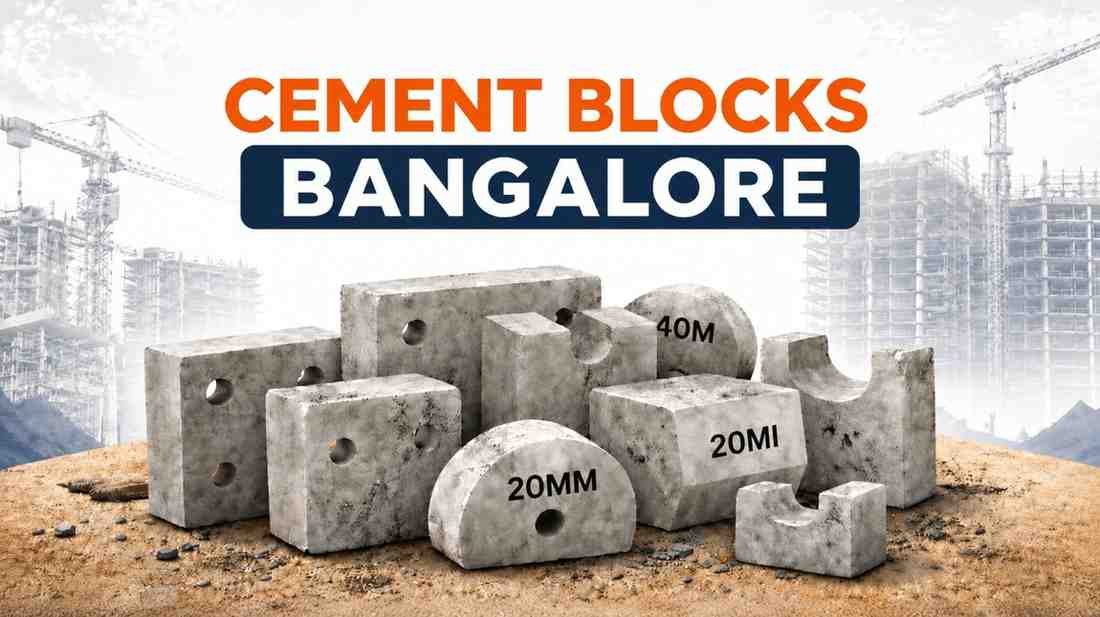
Bangalore's construction market stocks a wide variety of cement blocks. Understanding which type suits your project is the first step to buying right.
Solid Concrete Blocks
These are dense, heavy units used for load-bearing walls, compound walls, and wherever structural strength is the priority. They have excellent compressive strength and are manufactured in standard sizes that align with IS 2185 specifications.
Solid blocks are the most widely used type on residential plots and housing layouts across Bangalore.
Hollow Concrete Blocks
Lighter than solid blocks, hollow units are popular for partition walls and non-load-bearing sections. The hollow cores reduce weight on the structure and also offer a degree of thermal insulation, which is genuinely useful in Bangalore's warm climate.
I've noticed that a lot of builders in Bangalore's apartment sector have shifted toward hollow blocks for internal walls precisely because they reduce the dead load on slabs without compromising on partition integrity.
Concrete Cover Blocks
This is where many buyers, even experienced ones, get tripped up. Concrete cover blocks are not wall blocks. They are small, precisely-made spacer units placed under or around reinforcement steel before concrete is poured.
Their job is to ensure the steel sits at the correct distance from the formwork surface, creating the required concrete cover. Without adequate cover, steel corrodes. Corrosion leads to cracking and spalling. The whole structure weakens over time.
Goyal Cement Blocking specialises in manufacturing high-grade concrete cover blocks that maintain dimensional consistency across large production batches, something that local unregulated units often struggle with.
PVC Cover Blocks
PVC cover blocks serve the same purpose as concrete cover blocks but are made from high-density plastic. They are particularly valued in environments with high humidity or near water bodies, where corrosion risk is elevated.
They clip cleanly onto rebar, stay in position during pouring, and are reusable in certain formwork applications. For basement work and underground structures in Bangalore, they are increasingly preferred.
Paver Tile Blocks
Used extensively in driveways, pathways, parking zones, and landscaped areas, paver blocks combine aesthetics with load-bearing function. They interlock to distribute weight evenly and can handle both foot and vehicular traffic.
Bangalore's villa communities, IT campuses, and public spaces have seen a sharp rise in paver block usage over the last decade. The variety of shapes and finishes available makes them a designer's material as much as an engineer's.
Concrete Chequered Tiles
These are slip-resistant flooring units with a raised surface pattern. They are standard in industrial floors, bus depots, warehouses, and any public area prone to water spillage. The textured surface provides traction underfoot and reduces accident risk significantly.
Pilling Blocks
Pilling blocks are used during deep foundation work. They are placed inside the pile bore to support the reinforcement cage at the correct position before concrete is poured. For high-rise buildings, flyovers, and metro-type infrastructure, they are a critical component that rarely gets talked about but always gets used.
Precast Concrete Blocks
Manufactured under controlled factory conditions and delivered ready to install, precast blocks save considerable time on-site. They are dimensionally accurate, well-cured, and consistent in strength. Bangalore's larger infrastructure and housing development projects have adopted precast solutions extensively.
Why Quality Certification Is Non-Negotiable
When you are buying cement blocks in Bangalore, the single most important thing to check is whether the product conforms to the relevant Indian Standard.
Here is a quick reference:
- IS 2185 covers solid and hollow concrete masonry units
- IS 15658 covers precast concrete paving blocks
- IS 456 governs concrete cover requirements for RCC structures
A manufacturer who can show you test certificates aligned with these standards is one you can trust. One who cannot should prompt immediate concern.
According to the Bureau of Indian Standards, blocks that meet IS 2185 grade designations must pass compressive strength tests, water absorption checks, and dimensional tolerance reviews before certification. That is not a box-ticking exercise. It is the difference between a wall that lasts and one that does not.
How to Evaluate a Cement Block Supplier Before You Order
When I tried switching suppliers mid-project a few years back, the inconsistency in block dimensions alone caused alignment problems during laying. It was a lesson I did not forget. Getting your supplier right upfront saves far more headache than any cost saving justifies.
Here is what to look for:
- Ask for compressive strength test reports relevant to the specific block type you need
- Request a sample batch and check for surface cracks, uniform colour, and consistent dimensions
- Confirm the manufacturing process — machine-pressed blocks are significantly more reliable than manually cast ones
- Check the curing process — properly water-cured blocks perform better than those that have been rush-dried
- Clarify delivery terms — ex-factory and delivered-to-site are very different numbers
- Verify IS standard compliance especially if you are working on a government tender or a project with a structural consultant
Why Sourcing from the Right Manufacturer Matters More Than Location
A common assumption in Bangalore's construction market is that buying locally always means better value. Not always true. What actually matters is the manufacturer's quality control, production capacity, and track record.
Goyal Cement Blocking, based in Palwal, Haryana, supplies concrete cover blocks, PVC cover blocks, paver tiles, chequered tiles, pilling blocks, and precast solutions to major projects across India, including Bangalore. Their client list includes L&T, Tata Projects, AFCONS, NCC, NCRTC, and Indian Oil, which reflects a level of quality verification that most local small-scale units simply cannot match.
For bulk orders where consistency matters, working with an established manufacturer who has already passed the scrutiny of large infrastructure clients is genuinely lower risk than sourcing from an untested local unit.
Practical Advice for Cement Block Buyers in Bangalore
A few things I have learned from watching projects go right and wrong:
Do not let price be your only filter. A block that is cheaper per unit but inconsistent in strength will cost you far more in rejected batches, slow laying, and structural rework.
Talk to your structural engineer before you order. They will specify the exact grade and type needed. Buying the wrong grade because it was cheaper or faster to source is an expensive mistake.
Plan your order schedule properly. Ordering in rushed small batches always costs more per unit. If storage is available, ordering ahead in bulk brings the per-unit cost down meaningfully.
Inspect the first delivery. Do not assume subsequent deliveries match the sample. A quick check on dimensions, weight, and surface condition at the time of delivery catches problems before they become problems on-site.
Cement blocks in Bangalore are not a single product. They are a family of materials, each with a specific role, and choosing the right one for the right application is what separates a project that holds up from one that causes problems years down the line.
If you are sourcing for a current or upcoming project, Goyal Cement Blocking offers a full product range with documented quality standards and the capacity to supply at scale. Reaching out for a consultation or sample request before committing to a bulk order is always a smart first step.
Cement blocks in Bangalore are not a single product. They are a family of materials, each with a specific role, and choosing the right one for the right application is what separates a project that holds up from one that causes problems years down the line.
If you are sourcing for a current or upcoming project, Goyal Cement Blocking offers a full product range with documented quality standards and the capacity to supply at scale. Reaching out for a consultation or sample request before committing to a bulk order is always a smart first step.