These innovative blocks have transformed modern construction by offering a faster and more practical alternative to many traditional building methods.
Whether you are planning a residential boundary wall, a commercial project, a retaining structure, or a landscaping feature, interlocking block systems provide excellent structural performance while simplifying construction. Their popularity continues to grow because they help builders achieve strong results with greater efficiency.
At Goyal Cement Blocking, we have seen firsthand how interlocking systems are helping contractors and property owners complete projects more effectively while maintaining high construction standards.
What Are Interlocking Cement Blocks?
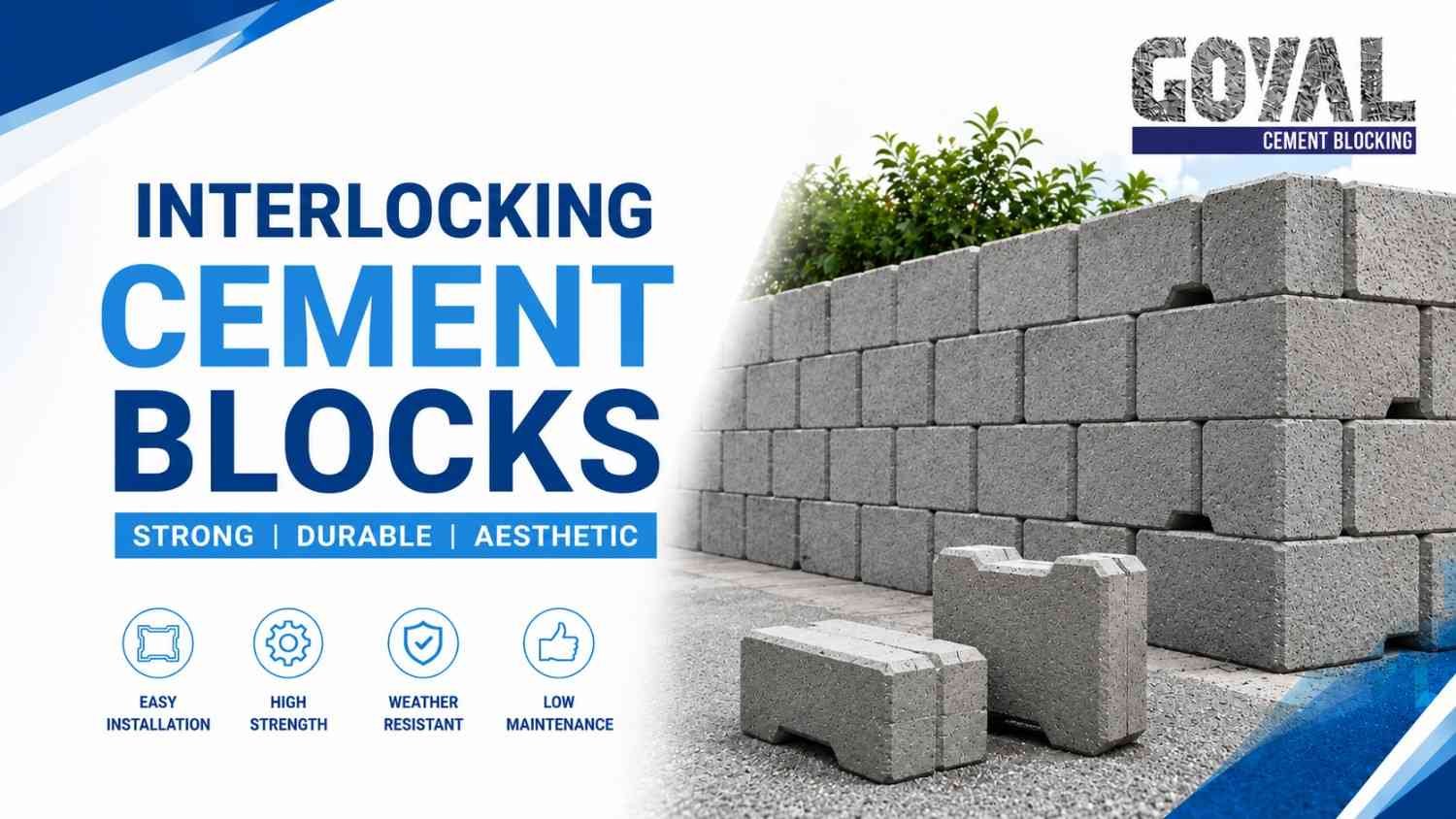
Interlocking cement blocks are specially designed precast blocks manufactured to connect securely with one another through a locking mechanism. Unlike conventional bricks that often depend heavily on mortar, these blocks are engineered to fit together with precision.
The concept is simple but highly effective.
Each block contains specific grooves, projections, or shapes that allow it to lock into adjacent units. This creates a stable structure where loads are distributed efficiently throughout the wall or installation.
Think of it like assembling a carefully designed puzzle. Each piece contributes to the strength of the overall structure.
Why Interlocking Cement Blocks Are Becoming More Popular
Builders and developers are always looking for ways to improve construction efficiency without compromising durability.
Interlocking systems offer several advantages that make them increasingly attractive.
Some key reasons include:
- Faster installation
- Improved structural stability
- Reduced construction waste
- Enhanced durability
- Consistent product quality
- Lower maintenance requirements
- Flexible design possibilities
When I tried comparing traditional masonry with interlocking systems on a site visit, the difference in installation speed was immediately noticeable. The construction team was able to complete large sections much more efficiently.
Benefits of Interlocking Cement Blocks
Strong Structural Performance
One of the biggest strengths of interlocking cement blocks is their ability to create stable and durable structures.
The interlocking design helps distribute loads across multiple units, improving overall performance.
Faster Construction
Construction schedules often influence project success.
Because these blocks are manufactured with precise dimensions, they can be installed more quickly than many conventional alternatives.
Reduced Material Waste
Precision manufacturing helps minimize waste during construction.
This contributes to cleaner and more efficient building practices.
Long-Term Durability
High-quality cement blocks are designed to withstand environmental exposure, moisture, and varying weather conditions.
Easy Maintenance
I've noticed that properly installed interlocking structures generally require minimal maintenance over time.
That can be a significant benefit for both residential and commercial property owners.
Common Applications of Interlocking Cement Blocks
Boundary Walls
Interlocking blocks are widely used for creating strong and durable perimeter walls.
Residential Construction
Homeowners often use these blocks for:
- Compound walls
- Garden features
- Utility structures
- Landscape boundaries
Retaining Walls
The structural strength of interlocking systems makes them suitable for retaining wall applications.
Commercial Projects
Commercial developments benefit from the speed and reliability of interlocking construction methods.
Industrial Facilities
Industrial environments often require durable wall systems capable of handling demanding conditions.
How Interlocking Cement Blocks Work
The effectiveness of interlocking blocks comes from their design.
Mechanical Connection
Each block connects securely with surrounding units.
Load Distribution
Loads are transferred across the system rather than concentrated in isolated areas.
Improved Stability
The interlocking mechanism helps reduce movement and maintain alignment.
Construction Efficiency
The design simplifies installation and contributes to faster project completion.
Types of Interlocking Cement Blocks
Different construction projects require different block configurations.
Solid Interlocking Blocks
Solid blocks provide excellent strength and are suitable for structural applications.
Hollow Interlocking Blocks
Hollow blocks reduce weight while maintaining structural integrity.
Decorative Blocks
Decorative options combine functionality with visual appeal.
Retaining Wall Blocks
These blocks are engineered to resist soil pressure and provide stability.
Modular Construction Blocks
Modular systems allow flexibility for projects of various sizes and complexities.
Why Durability Matters in Construction
A building material should perform not only today but also decades into the future.
Environmental exposure, moisture, temperature fluctuations, and structural loads all influence long-term performance.
According to research published by the International Association for Shell and Spatial Structures, properly designed interlocking masonry systems can offer excellent structural behavior and long service life when manufactured and installed correctly.
This is why selecting quality blocks from reputable manufacturers is so important.
In my experience, durability often depends on both product quality and proper installation practices.
Choosing the Right Interlocking Cement Blocks
Selecting the right block system involves evaluating several factors.
Understand Your Project Requirements
Different applications require different levels of structural performance.
Consider Environmental Conditions
Climate and exposure conditions should influence material selection.
Verify Manufacturing Quality
Look for:
- Consistent dimensions
- Smooth surfaces
- Uniform density
- Reliable strength
Assess Structural Needs
Consider:
- Wall height
- Load requirements
- Site conditions
- Design objectives
Work with a Trusted Manufacturer
Reliable manufacturers help ensure product consistency and long-term performance.
Many builders choose Goyal Cement Blocking because consistent manufacturing standards contribute to dependable construction outcomes.
Installation Process
Proper installation is critical to maximizing the benefits of interlocking cement blocks.
Step 1: Site Preparation
The construction area is cleared and prepared according to project specifications.
Step 2: Foundation Construction
A stable foundation supports the entire structure.
Step 3: First Course Placement
The first row is carefully aligned to establish accurate positioning.
Step 4: Interlocking Assembly
Additional blocks are installed and connected through the locking system.
Step 5: Alignment Checks
Regular inspections ensure proper wall alignment.
Step 6: Finishing Work
The completed structure is inspected and finished as required.
Environmental Advantages of Interlocking Cement Blocks
Sustainability is becoming increasingly important across the construction industry.
Interlocking systems support environmentally responsible building practices by offering:
- Reduced material waste
- Efficient resource utilization
- Long service life
- Minimal maintenance requirements
These benefits contribute to more sustainable construction projects.
Comparing Interlocking Cement Blocks with Traditional Masonry
| Feature | Interlocking Cement Blocks | Traditional Masonry |
|---|---|---|
| Installation Speed | Faster | Slower |
| Structural Stability | Excellent | Good |
| Material Waste | Lower | Higher |
| Dimensional Accuracy | High | Moderate |
| Maintenance | Lower | Moderate |
| Durability | High | High |
For many projects, these advantages make interlocking systems an attractive choice.
Why Contractors Prefer Interlocking Cement Blocks
Construction professionals value solutions that simplify project execution while maintaining quality.
Interlocking cement blocks provide:
- Consistent performance
- Faster construction
- Reliable durability
- Design flexibility
- Reduced labor complexity
When I visited a commercial construction project using interlocking blocks, the contractor explained how much easier it was to maintain alignment and consistency throughout the installation process.
That practical efficiency is one reason demand continues to grow.
Future of Interlocking Construction Systems
Construction methods continue to evolve toward greater efficiency and sustainability.
Interlocking cement blocks support these goals by offering:
- Faster project delivery
- Improved structural reliability
- Sustainable construction practices
- Long-term durability
As technology advances and construction requirements become more demanding, interlocking systems are expected to remain a preferred choice across many sectors.
Goyal Cement Blocking continues to support this evolution by providing quality products designed for modern construction needs.