
The challenge is that many buyers focus only on pricing and overlook important factors like block quality, strength, durability, manufacturing standards, and supplier reliability. A cheaper block may appear attractive initially, but poor-quality materials often result in higher maintenance and repair expenses later.
At Goyal Cement Blocking, we have worked with contractors, builders, architects, and property owners who consistently prioritize quality and long-term value when selecting concrete blocks for their projects.
Understanding Concrete Blocks and Their Importance
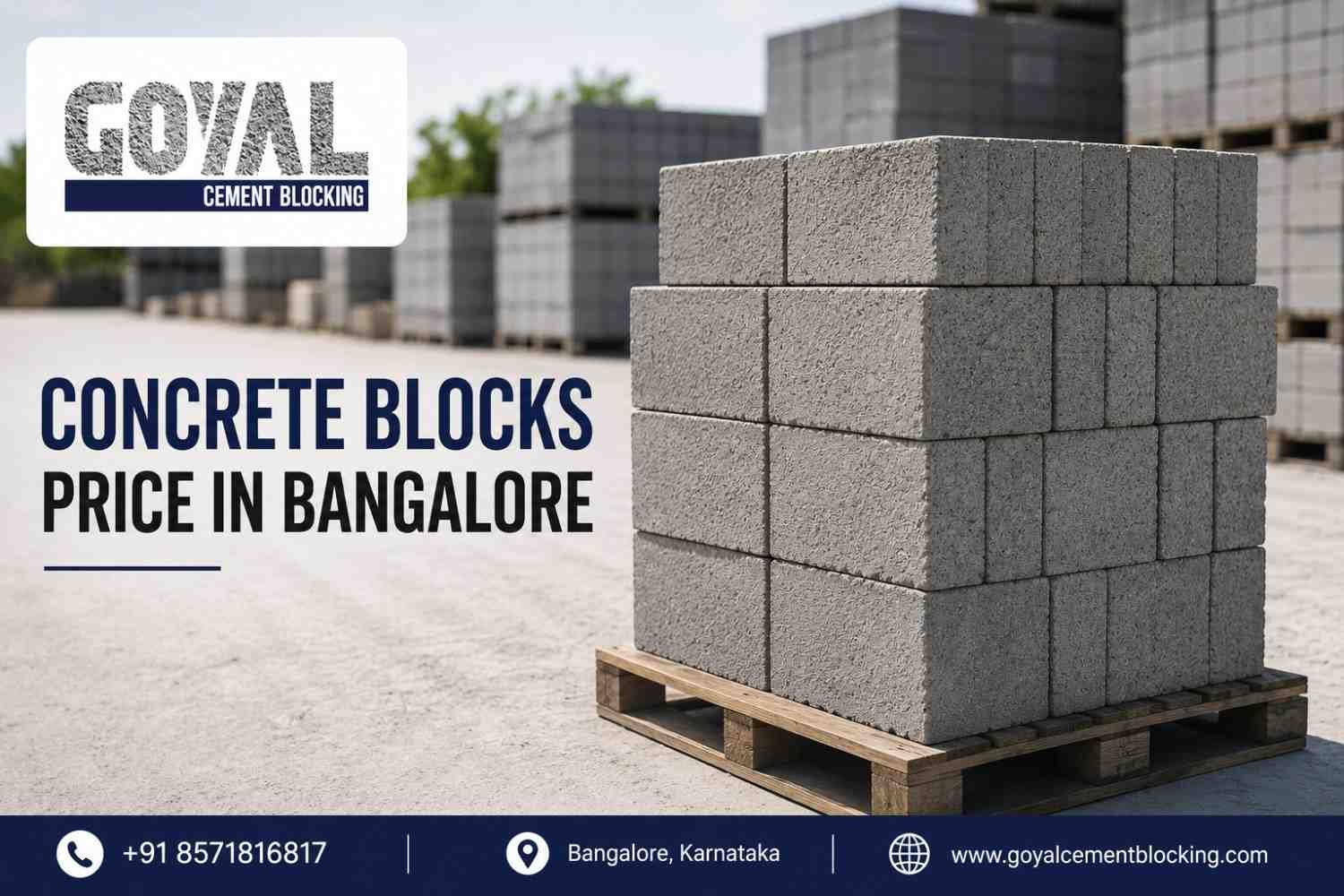
Concrete blocks are precast construction units manufactured using cement, aggregates, water, and carefully controlled production methods. They are widely used for walls, foundations, partitions, retaining structures, and various other building applications.
Their popularity comes from several advantages:
- High compressive strength
- Excellent durability
- Faster construction
- Better dimensional accuracy
- Reduced maintenance requirements
- Resistance to weather conditions
- Improved fire resistance
In my experience, projects built using quality concrete blocks often achieve better structural stability and smoother construction progress compared to traditional alternatives.
Why People Search for Concrete Blocks Price in Bangalore
Bangalore continues to experience rapid residential, commercial, and industrial growth. New housing developments, office complexes, warehouses, educational institutions, and infrastructure projects create significant demand for construction materials.
When people search for concrete blocks price in Bangalore, they are usually trying to:
- Estimate project budgets
- Compare building materials
- Understand market availability
- Select suitable block types
- Identify reliable manufacturers
- Improve construction efficiency
However, pricing should always be evaluated alongside product quality and technical specifications.
Factors That Influence Concrete Blocks Price in Bangalore
Several variables influence the market value of concrete blocks. Understanding these factors helps buyers make informed purchasing decisions.
Raw Material Quality
The quality of cement, aggregates, sand, and water used during manufacturing significantly impacts the final product.
Premium-grade materials typically produce blocks with:
- Higher strength
- Better durability
- Improved finish
- Consistent dimensions
I've noticed that reputable manufacturers invest heavily in quality control because it directly affects long-term building performance.
Manufacturing Technology
Modern block manufacturing plants use automated systems and advanced machinery to ensure consistency.
Benefits include:
- Uniform block dimensions
- Better density
- Enhanced strength
- Reduced defects
Advanced production methods contribute significantly to the reliability of concrete blocks.
Block Type
Different types of blocks serve different construction purposes.
Common options include:
Solid Concrete Blocks
Solid blocks provide excellent load-bearing capacity and structural strength. They are widely used in residential and commercial construction.
Hollow Concrete Blocks
Hollow blocks reduce structural weight while maintaining strength. They also offer better thermal and sound insulation.
Partition Blocks
These blocks are commonly used for internal walls and non-load-bearing applications.
Paver Blocks
Although different from wall blocks, paver blocks are extensively used in landscaping, parking areas, walkways, and outdoor spaces.
Block Size and Dimensions
Larger blocks typically cover more wall area and can speed up construction. Different projects require different block dimensions based on structural requirements and architectural designs.
Transportation and Logistics
Delivery distance, project location, and transportation requirements can influence the overall procurement cost.
For large-scale projects, efficient logistics planning often contributes significantly to material management.
Types of Concrete Blocks Used in Bangalore Construction Projects
Choosing the correct block type is essential for performance and durability.
Load-Bearing Concrete Blocks
These blocks are designed to support structural loads from roofs, floors, and upper building levels.
Applications include:
- Residential buildings
- Commercial structures
- Industrial facilities
- Boundary walls
Non-Load-Bearing Blocks
Used primarily for partitions and internal walls where structural support is not required.
Applications include:
- Office partitions
- Interior walls
- Educational institutions
- Retail spaces
Lightweight Concrete Blocks
Lightweight blocks help reduce dead load while improving handling efficiency during construction.
High-Strength Concrete Blocks
These are used in demanding environments requiring exceptional structural performance.
Advantages of Using Quality Concrete Blocks
Many contractors continue choosing concrete blocks because of their proven benefits.
Faster Construction
Concrete blocks are larger than conventional bricks, allowing workers to cover more area in less time.
This often leads to:
- Reduced labor requirements
- Faster project completion
- Improved site productivity
Better Structural Performance
Quality blocks provide excellent compressive strength and stability.
According to various construction industry studies, properly manufactured concrete masonry units contribute significantly to the overall structural integrity of buildings when installed according to engineering specifications.
Fire Resistance
Concrete blocks naturally resist fire better than many alternative materials.
This characteristic makes them suitable for:
- Residential buildings
- Commercial properties
- Industrial facilities
- Educational institutions
Sound Insulation
Dense concrete blocks help reduce noise transmission between rooms and buildings.
Weather Resistance
Concrete blocks perform well under varying environmental conditions, making them suitable for long-term use.
How to Evaluate Concrete Block Quality
Before finalizing a supplier, examine several quality indicators.
Dimensional Accuracy
Blocks should have consistent dimensions.
Accurate sizing helps achieve:
- Straight walls
- Better alignment
- Reduced mortar consumption
- Improved aesthetics
Surface Finish
The block surface should be smooth and free from significant defects.
Compressive Strength
Strength testing is one of the most important quality parameters.
Builders should always verify that blocks meet relevant construction standards.
Density and Weight
Uniform density indicates controlled manufacturing practices.
Water Absorption
Quality blocks should maintain acceptable water absorption levels to support long-term durability.
Applications of Concrete Blocks
Concrete blocks are among the most versatile construction materials available.
Residential Construction
Used for:
- Houses
- Villas
- Apartments
- Compound walls
Commercial Buildings
Suitable for:
- Offices
- Shopping centers
- Hotels
- Educational institutions
Industrial Projects
Widely used in:
- Warehouses
- Factories
- Manufacturing facilities
- Storage units
Infrastructure Projects
Concrete blocks also support:
- Utility structures
- Public facilities
- Landscaping projects
- Retaining walls
Choosing the Right Concrete Block Supplier
Finding the right supplier is just as important as selecting the right block.
Check Manufacturing Standards
Reliable manufacturers maintain strict quality control procedures throughout production.
Verify Industry Experience
Experienced suppliers understand project requirements and can recommend suitable products.
When I tried evaluating suppliers for a large commercial project, experience often proved more valuable than aggressive sales claims.
Review Product Range
A supplier offering multiple block varieties can better support diverse construction requirements.
Assess Production Capacity
Large projects require consistent supply schedules.
Choose manufacturers capable of meeting project timelines without compromising quality.
Look for Technical Support
Knowledgeable suppliers help builders select appropriate block types based on structural needs.
Why Builders Trust Goyal Cement Blocking
Goyal Cement Blocking has built a reputation for supplying dependable concrete products that meet modern construction requirements.
Builders and contractors choose the company because of:
- Consistent manufacturing standards
- High-quality raw materials
- Reliable supply capabilities
- Wide product range
- Strong industry experience
- Focus on customer satisfaction
Whether the project involves residential construction, commercial development, industrial expansion, or infrastructure work, quality remains a critical priority.
Many customers researching concrete blocks price in Bangalore ultimately realize that durability, performance, and supplier reliability provide greater long-term value than focusing solely on initial procurement costs.
Common Mistakes Buyers Should Avoid
Many first-time buyers make decisions that affect project performance later.
Avoid these mistakes:
- Choosing blocks based only on cost
- Ignoring quality certifications
- Overlooking dimensional accuracy
- Skipping strength verification
- Not checking supplier reputation
- Ignoring transportation planning
- Selecting the wrong block type
A little research upfront can prevent expensive construction issues later.
Future Demand for Concrete Blocks in Bangalore
Bangalore's continued growth is expected to sustain strong demand for concrete blocks across residential, commercial, and industrial sectors.
Modern construction trends increasingly emphasize:
- Faster project completion
- Sustainable building practices
- Improved structural performance
- Efficient material usage
Concrete blocks align well with these objectives, making them a preferred choice for builders and developers.