Cement bricks are one of the most fundamental building materials in any structural project, whether you are building a boundary wall, laying a driveway, or working on a large commercial complex. But pricing is rarely straightforward. It depends on the type of block, the grade, the supplier, and even the quantity you order.
Let me walk you through all of it, plainly and practically.
Why Cement Brick Costs Vary So Much in Bangalore
Bangalore has one of the most active construction markets in India. New residential layouts, IT campuses, metro extensions, and road projects are all running simultaneously. That level of demand naturally creates variation in pricing across suppliers.
In my experience, a lot of buyers make the mistake of comparing prices without comparing like for like. A cheap cement brick from an unknown local supplier might look appealing on paper. But if the compressive strength is off, you will pay far more in repairs and replacements down the road.
There are several factors that genuinely drive the cost of cement bricks in Bangalore:
- Raw material quality – The grade of cement, aggregate, and water used in manufacturing directly impacts both strength and price
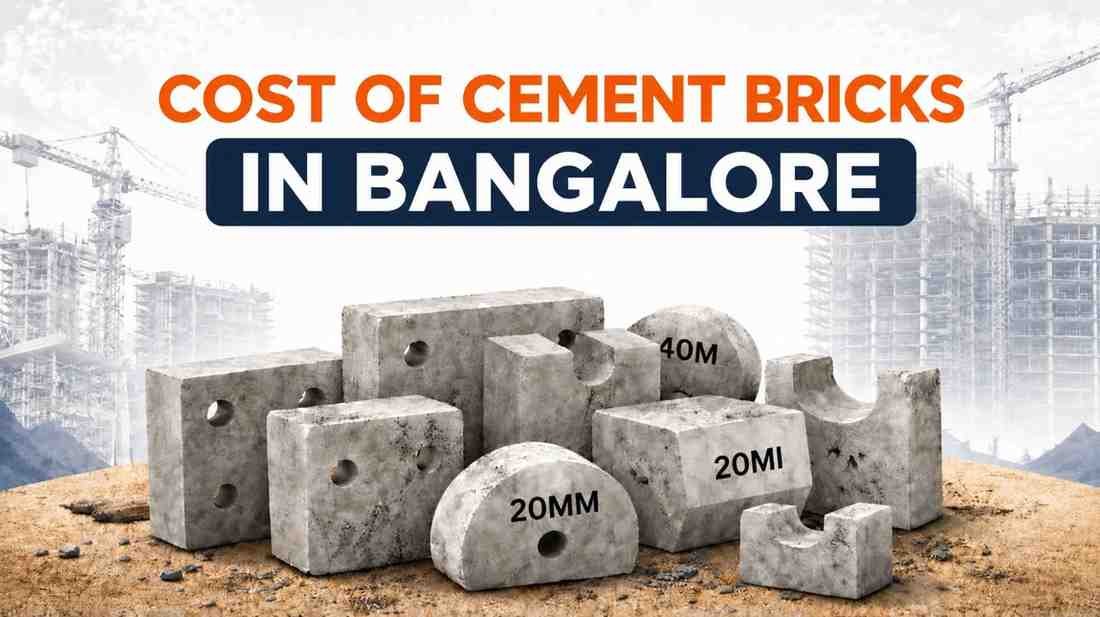
- Block type – Solid blocks, hollow blocks, cover blocks, paver blocks, and chequered tiles all have different production costs
- Manufacturing method – Machine-pressed blocks are more consistent and durable than manually made ones
- Order volume – Bulk orders almost always bring down per-unit cost significantly
- Transportation distance – Bangalore buyers sourcing from established manufacturers in Haryana or nearby states should factor in logistics
- Certifications and testing – Blocks that meet IS standards or have been third-party tested typically cost a bit more, and they are worth it
Types of Cement Blocks and What They Are Used For
Before you can meaningfully compare costs, you need to know which type of block you actually need. Using the wrong product is one of the most expensive mistakes in construction.
Concrete Cover Blocks
These are small but critically important. Concrete cover blocks are used to maintain the correct spacing between reinforcement steel and the formwork or ground. They ensure your RCC structure has the right concrete cover, which protects steel from corrosion and moisture.
I've noticed that a lot of contractors in Bangalore underestimate the importance of cover blocks until they see a finished slab with surface cracks caused by inadequate cover. It is a preventable problem.
Goyal Cement Blocking manufactures high-quality concrete cover blocks designed to perform consistently under load. They are available in different thicknesses to suit beams, slabs, columns, and foundation work.
PVC Cover Blocks
PVC cover blocks are a lighter, non-corrosive alternative to concrete cover blocks. They are especially useful in projects near the coast or in high-humidity zones where steel reinforcement is more vulnerable. They snap on to the rebar cleanly and hold position well even when concrete is being poured.
Paver Tile Blocks
Paver blocks are used for driveways, pathways, parking lots, and landscaped areas. They are designed to handle vehicular and foot traffic while keeping the surface visually neat. In Bangalore's villa communities and tech parks, interlocking paver tiles are extremely popular.
The cost depends heavily on the thickness, shape, and whether you need standard grey or coloured variants.
Concrete Chequered Tiles
These are slip-resistant tiles widely used in industrial floors, walkways, bus depots, and public spaces. The raised diamond or chequer pattern gives traction underfoot, which matters a great deal in warehouses or any area prone to water exposure.
Pilling Blocks
Pilling blocks (also called pile cover blocks) are used specifically during foundation piling work. They support the reinforcement cage inside the pile bore, ensuring correct positioning before concrete is poured. For projects with deep foundations, like high-rises or flyovers, these are non-negotiable.
Precast Concrete Blocks
Precast blocks are manufactured off-site under controlled conditions and then transported to the construction site. They are consistent, faster to install, and reduce on-site waste. Bangalore's infrastructure projects and housing developments have increasingly adopted precast solutions.
How to Get the Best Value When Buying Cement Bricks in Bangalore
Getting value is not the same as getting the cheapest rate. When I tried sourcing blocks purely on lowest price for a project a few years ago, the inconsistency in block dimensions alone caused issues during laying. It slowed the work down considerably.
Here is what genuinely helps when evaluating costs:
1. Ask for compressive strength data Any reputable manufacturer should be able to share test results. For standard load-bearing applications, you typically need blocks with a minimum compressive strength of 3.5 N/mm². For structural use, that number should be higher.
2. Calculate cost per unit vs. cost per project A slightly higher per-unit price from a consistent manufacturer can actually reduce your overall project cost if it means less wastage, fewer rejections, and smoother laying.
3. Factor in delivery terms Some suppliers quote ex-factory prices. Others include delivery. Make sure you are comparing the landed cost, not just the base rate.
4. Check for IS standard compliance Blocks conforming to IS 2185 (for concrete masonry units) or IS 15658 (for paver blocks) meet tested benchmarks. This matters especially if you are working on a government tender or a project with a structural consultant.
According to the National Council for Cement and Building Materials (NCCBM), standardised concrete blocks can reduce overall wall construction time by up to 30% compared to traditional brick masonry, which adds indirect cost savings to the equation.
Why Sourcing from Established Manufacturers Matters
Bangalore has dozens of small block-making units. Some are good. Many are inconsistent. The challenge for buyers is that it is hard to tell from a sample batch how the product will perform at scale.
In my experience, the manufacturers who have been supplying large infrastructure clients over years tend to be more reliable, not because they are expensive, but because they have had to maintain quality standards to retain those relationships.
Goyal Cement Blocking, based in Palwal, Haryana, has been supplying cover blocks, paver tiles, chequered tiles, and precast solutions across India, including to major clients in Bangalore, for nearly a decade. Their client portfolio includes names like L&T, Tata Projects, AFCONS, and NCRTC, which says something about how their products perform under serious project scrutiny.
If you are evaluating manufacturers for a Bangalore project, it is worth requesting samples and a product specification sheet before placing any bulk order.
Practical Tips for Reducing Your Total Block Cost
Without cutting corners on quality, there are genuine ways to bring your total spend down:
- Order in bulk where storage permits. Per-unit rates drop noticeably at larger volumes.
- Plan your block schedule so you are not ordering in rushed, small batches, which always costs more.
- Use the right block for the right application. Overspecifying (using a high-grade block where a standard one would work) adds unnecessary cost. Underspecifying does the same through failures and rework.
- Get at least three quotes but always check what each quote includes in terms of grade, testing, and delivery.
- Talk to your structural engineer first. They will specify the exact grades needed. Buying the wrong grade is an expensive mistake.
Whether you are a builder, contractor, or an individual managing your own construction, understanding the cost of cement bricks in Bangalore means looking beyond the number on a quotation. Quality, consistency, grade, and supplier reliability are all part of what you are actually paying for.
Goyal Cement Blocking offers a range of products suited to projects of all scales, and reaching out for a product-specific quote is a practical first step if you want accurate numbers for your specific application.
Whether you are a builder, contractor, or an individual managing your own construction, understanding the cost of cement bricks in Bangalore means looking beyond the number on a quotation. Quality, consistency, grade, and supplier reliability are all part of what you are actually paying for.
Goyal Cement Blocking offers a range of products suited to projects of all scales, and reaching out for a product-specific quote is a practical first step if you want accurate numbers for your specific application.