
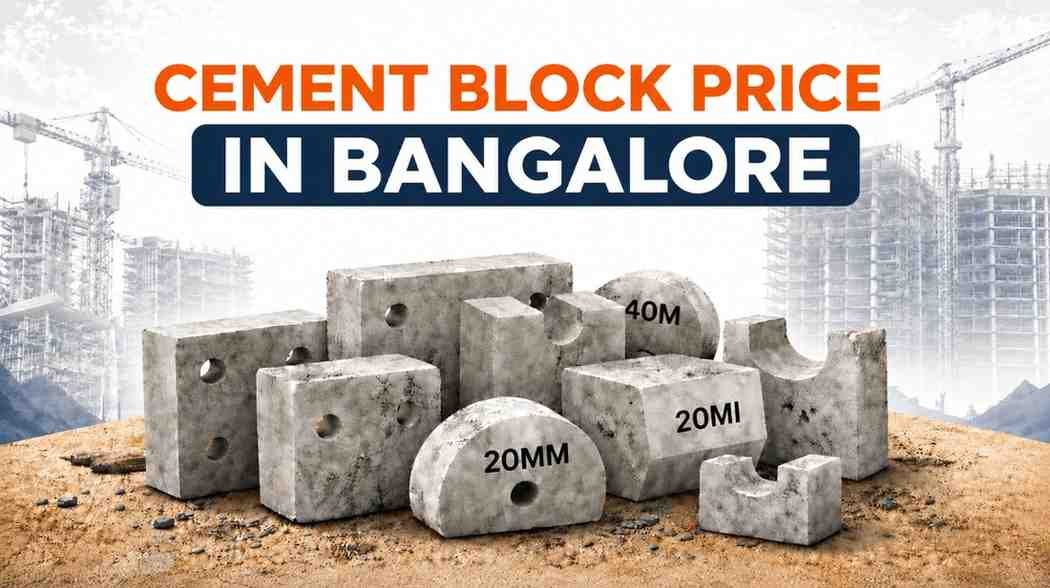
This is not a price list. It is something more useful: a clear explanation of what actually determines what you pay, what traps to avoid, and how to make sure you are comparing like with like when you get quotes.
Why Cement Block Price in Bangalore Varies So Widely
Bangalore has a construction boom that shows no sign of slowing. Residential layouts, commercial towers, metro extensions, and road infrastructure are all running simultaneously across the city. That level of demand means suppliers range from large organised manufacturers to small backyard units, and the price gap between them can be significant.
But here is the thing people miss: that price gap is not arbitrary. It reflects real differences in what you are actually getting.
Several factors drive the cement block price in Bangalore:
- Raw material grade - the quality of cement, aggregate, and water used in production directly affects both strength and cost
- Manufacturing method - machine-pressed and vibration-compacted blocks cost more to produce but perform far more consistently than manually cast ones
- Block type and grade - solid blocks, hollow blocks, cover blocks, paver blocks, and precast units all have different production costs and therefore different price points
- IS standard compliance - blocks manufactured to Bureau of Indian Standards specifications require testing, documentation, and quality control that add cost but deliver reliability
- Order volume - bulk orders consistently bring down per-unit cost, sometimes substantially
- Curing process - properly water-cured blocks take longer to produce but significantly outperform rush-dried alternatives in compressive strength
- Logistics and delivery - ex-factory and delivered-to-site rates can differ considerably depending on distance
Understanding these factors means you stop asking "who is cheapest" and start asking "who gives me the best value per unit of actual performance."
Types of Cement Blocks and What Affects Their Individual Cost
Solid Concrete Blocks
Solid concrete blocks are among the most widely used products on Bangalore construction sites. They are dense, strong, and suited for load-bearing walls, compound walls, and boundary structures.
Their price is driven mainly by the cement grade used, the aggregate quality, and the compressive strength grade specified. Blocks conforming to IS 2185 Grade D or higher carry a premium because they have been tested and certified.
In my experience, the most common mistake buyers make here is ordering the lowest-grade solid block for an application that actually needs a higher grade. The short-term saving evaporates quickly when the engineer flags a structural concern.
Hollow Concrete Blocks
Hollow blocks cost less per unit than solid ones, mainly because they use less material. They are suited for partition walls, non-load-bearing infill, and sections of the structure where reducing dead load on the slab is a priority.
What affects their price is largely the wall thickness of the hollow section and the grade of mix used. Thinner walls mean less material and lower cost, but also less strength. For partition use, that trade-off is usually acceptable. For boundary walls in exposed locations, it may not be.
Concrete Cover Blocks
These small units get overlooked in most conversations about construction costs. They should not be.
Concrete cover blocks are the spacers placed under and around reinforcement steel before concrete is poured. They maintain the required distance between the steel and the formwork surface, ensuring adequate concrete cover over the rebar. Without this cover, steel corrodes. Corrosion causes cracking and structural failure over time.
I've noticed that cover blocks are often treated as an afterthought on smaller sites. Contractors buy whatever is cheapest and available. But the compressive strength and dimensional accuracy of a cover block matters. A block that crumbles or shifts under the weight of poured concrete defeats the entire purpose.
Goyal Cement Blocking manufactures concrete cover blocks with consistent dimensional tolerances and tested compressive strength, specifically because the performance of these small units has outsized structural consequences.
The price of cover blocks varies by thickness. Thicker blocks for foundation work cost more than thinner ones used for slabs. But the quantity used on a typical project means the total cover block cost is a small fraction of the overall material budget.
PVC Cover Blocks
PVC cover blocks serve the same positioning function as concrete ones but are made from high-density polymer. They are lighter, non-corrosive, and particularly suited to below-grade applications, basement structures, and coastal or high-humidity environments.
They carry a slight premium over basic concrete cover blocks because of the material. But for the right application, they are the better long-term choice and the additional cost is well justified.
Paver Tile Blocks
Paver blocks have become a significant part of Bangalore's urban landscape. Driveways, pedestrian pathways, parking zones, IT campus courtyards, and public streetscapes all use interlocking paver units.
Their price is driven by thickness, mix grade, shape complexity, and whether pigmentation is required. A standard grey 60mm paver block costs less than a coloured 80mm unit with a geometric profile. Both have their place; the application dictates the specification.
According to data from the Indian Concrete Institute, properly installed interlocking paver systems have a service life of over 25 years with minimal maintenance when the correct grade of block is used for the traffic loading involved. Buying on price alone can halve that service life.
Concrete Chequered Tiles
Used for industrial floors, loading bays, pedestrian ramps, and public areas, chequered tiles are priced based on size, thickness, and surface texture depth. The slip-resistance performance is directly linked to production quality, so this is another area where cutting corners on price has a tangible safety consequence.
Pilling Blocks
Pilling blocks are used during deep foundation construction to support the reinforcement cage at the correct position inside the pile bore before concrete is poured. They are a niche product but a critical one on high-rise and infrastructure projects.
Price varies by the load specification and dimensions required for the pile diameter being used.
Precast Concrete Blocks
Precast units are manufactured under factory conditions with precise mix design and curing protocols. They arrive on site ready to install and significantly reduce construction time.
The upfront cost per unit is higher than cast-in-situ equivalents, but the overall project economics often favour precast when you factor in reduced labour time, lower wastage, and faster programme delivery.
How to Get the Right Value, Not Just the Lowest Quote
When I tried comparing quotes from multiple suppliers in Bangalore without a clear specification document, I ended up comparing completely different products. One supplier quoted for a Grade C block, another for Grade D. The numbers looked similar; the actual products were not.
Here is a practical approach to make sure your comparisons are meaningful:
- Define your specification first - get your structural engineer to give you the IS grade, compressive strength, and block type required for each application on your project
- Ask every supplier to quote against that exact specification - do not let them substitute grades without explicitly telling you
- Request test certificates - ask for recent compressive strength and water absorption test results, not just verbal assurances
- Ask for a sample batch before committing to a bulk order - check dimensions, surface finish, and density consistency across the batch
- Clarify what the quoted price includes - whether delivery is included, what the minimum order quantity is, and what the lead time looks like
- Check the supplier's client track record - a manufacturer who has supplied to major infrastructure or commercial projects has already been through external quality scrutiny
Goyal Cement Blocking, which supplies across Bangalore and other major Indian cities, lists clients including L&T, Tata Projects, AFCONS, NCRTC, and Indian Oil. That kind of track record is a meaningful signal about production quality and supply reliability.
A Note on Bulk Ordering and Project Planning
One pattern I've noticed consistently across Bangalore construction projects is that reactive ordering always costs more. When materials run short mid-project and small emergency orders are placed, the per-unit cost jumps and delivery timelines stretch.
Planning your block requirements across the full project programme and ordering in appropriately sized batches gives you negotiating leverage on price and keeps the site running without delays.
If storage space is available on or near the site, ordering slightly ahead of schedule is almost always the right call.
Getting the cement block price in Bangalore right is not about finding the cheapest supplier. It is about understanding what you are paying for, specifying correctly, and choosing a manufacturer whose quality controls mean the blocks perform exactly as they should once they are in the ground or in the wall.
If you are planning a project and want to discuss product specifications or get a quote based on your actual requirements, Goyal Cement Blocking is worth a call before you commit to any bulk order.