
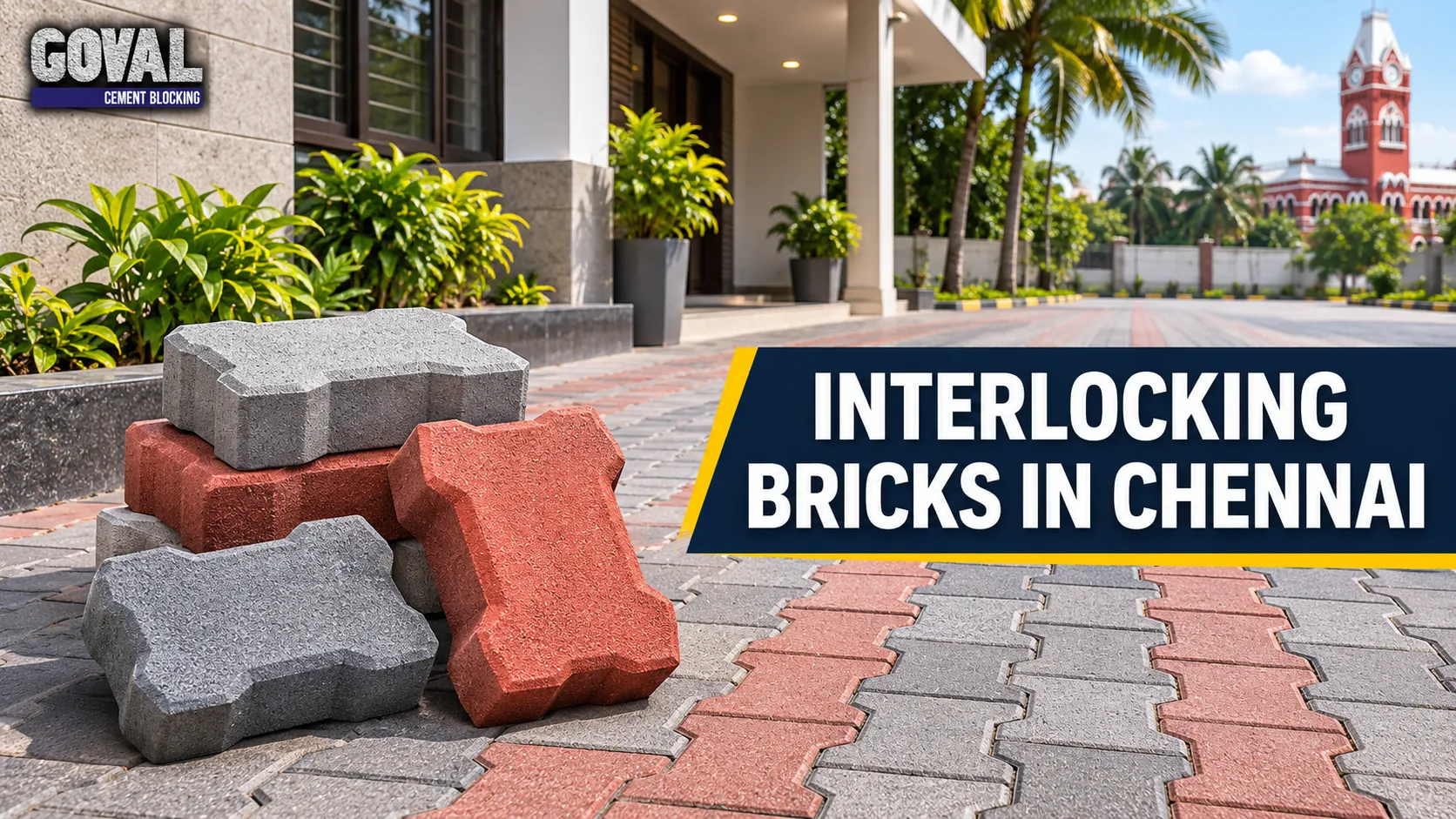
More homeowners in Chennai are looking at interlocking bricks as a way to cut down on plastering, mortar and labour without giving up a strong, good-looking wall. Instead of laying every brick on a thick bed of cement mortar, interlocking bricks fit together like building toys, with grooves and projections that lock each course into the one below.
This page explains how interlocking bricks in Chennai work, what they cost right now, the sizes on the market, how an interlocking bricks house is actually built, and where they make sense compared with solid blocks and red bricks. The prices below are ongoing market ranges from Chennai and nearby Tamil Nadu suppliers in late 2026. They are not a fixed rate card, so always confirm the final quote before you order.
What Are Interlocking Bricks?
Interlocking bricks are masonry units moulded with matching keys, grooves or lugs on their top and bottom faces. When you stack them, each brick sits firmly on the one below and cannot slide sideways. Most designs also have two vertical holes that line up through the wall, so steel bars and concrete grout can be added at corners, junctions and around openings.
There are two main families of interlocking bricks used around Chennai:
- Cement concrete interlocking bricks are pressed from cement, stone dust and aggregate. They are grey, dense and strong, and are used for load-bearing house walls, compound walls and commercial buildings.
- Mud or CSEB interlocking bricks (compressed stabilised earth blocks) are pressed from red soil stabilised with a small amount of cement. They have a natural reddish finish and are popular with people who want an exposed, eco-friendly look.
Both types share the same basic idea: precise sizes, tight joints and far less mortar than a conventional wall.
Interlocking Bricks Price in Chennai
Interlocking bricks price in Chennai is usually quoted per piece at the factory. Transport, loading and unloading are charged separately in most cases. Here is the current market range:
| Type | Common size (L × W × H) | Typical market price (per piece) |
|---|---|---|
| 6 inch cement interlocking brick | about 10 × 6 × 5 in | ₹33 – ₹45 |
| 9 inch cement interlocking brick | about 10 × 9 × 5 in | ₹43 – ₹55 |
| 6 inch mud / CSEB interlocking brick | about 10 × 6 × 5 in | ₹33 – ₹45 |
| 9 inch mud interlocking brick | about 10 × 9 × 5 in | ₹50 – ₹55 |
| Interlocking concrete block (larger) | 12 × 6 × 8 in | around ₹45 |
A few points to keep in mind when you read these figures:
- Supplier listings differ. Chennai-area manufacturers list 6 inch cement interlocking bricks at about ₹33, while some list 6 inch and 9 inch cement bricks at ₹40, and 9 inch versions from Kancheepuram go up to about ₹48.
- Mud bricks need bulk orders. Some Chennai suppliers of 6 inch mud interlocking bricks quote around ₹45 per piece with a minimum order of 900 pieces.
- Per-sq-ft quotes mean something else. A few builders quote interlocking work "per square foot". That usually covers construction, not just bricks, so compare it with full construction rates rather than brick prices.
So the honest answer to "what is the interlocking bricks price in Chennai?" is a range. Your final rate depends on the type, thickness, quantity and distance from the factory to your site.
Interlocking Brick Sizes in Chennai
Unlike standard concrete blocks, interlocking bricks do not have one universal size. Each machine and mould produces its own profile. In Chennai, these sizes are the most common:
- 6 inch (about 10 × 6 × 5 in): used for inner walls, first-floor walls and compound walls.
- 9 inch (about 10 × 9 × 5 in): used for outer load-bearing walls of houses where a thicker wall is needed.
- Half bricks: used to finish wall ends and openings neatly without cutting.
- U-shaped or channel bricks: used to form sill bands, lintel bands and roof bands that are filled with steel and concrete.
Because interlocking bricks from different makers rarely fit together, buy all the bricks for a project from one supplier and one mould. Ask for the exact length, width and height in writing before you place the order.
How Interlocking Bricks Construction in Chennai Works
Interlocking bricks construction in Chennai follows the same basic engineering as any load-bearing structure, but the wall goes up in a different way. Here is the usual sequence.
Foundation and plinth
The foundation is designed by a structural engineer, just like any other house. A level, accurate plinth beam is critical, because the first course of interlocking bricks sets the line for the whole wall. Any error at plinth level shows up all the way to the roof.
Laying the first course
The first course is set in a cement mortar bed to match the plinth exactly. After that, most courses are dry-stacked or laid with a thin cement slurry instead of a thick mortar joint. This is where most of the mortar saving comes from.
Vertical reinforcement and grouting
At corners, wall junctions, door and window edges, and at regular intervals along long walls, steel bars go down through the vertical holes. These holes are then filled with concrete grout. The result works like a series of small columns hidden inside the wall.
Bands and openings
U-shaped bricks form sill, lintel and roof bands. Steel and concrete go into these channels, tying the walls together horizontally. In a coastal city like Chennai, these bands also help the structure resist wind loads and cyclone-season gusts.
Finishing
Many owners leave interlocking walls exposed, with only a clear water-repellent coating. Others apply a thin plaster or texture on the outside. With Chennai's heavy northeast monsoon from October to December, the outer face must be properly sealed or finished, or water can seep through the joints.
Building an Interlocking Bricks House in Chennai
Interest in interlocking bricks houses in Chennai has grown because the method promises faster walls, cooler interiors and a distinctive exposed-brick look. Before you decide, it helps to know where interlocking bricks shine and where they need care.
Where interlocking bricks work well
- Independent houses up to G+1 or G+2, designed by an engineer who has experience with interlocking systems.
- Farmhouses, villas and weekend homes on the city's outskirts, where an exposed brick finish suits the setting.
- Compound walls and boundary walls, where speed and a neat finish matter.
- Small commercial units, workshops and godowns that need sturdy walls without heavy plastering.
Where you need extra care
- Multi-storey buildings need a proper structural design, often with an RCC frame, rather than relying only on load-bearing interlocking walls.
- Areas with poor drainage need a high plinth and good damp-proofing, because water at the base of the wall is the biggest enemy of any masonry.
- Unskilled masons can ruin the advantages of the system. Interlocking walls need careful levelling and alignment, so hire a team that has built with them before.
Cost picture for a house
General house construction in Chennai currently runs at roughly ₹1,940 to ₹2,640 per sq ft for standard packages. Interlocking construction does not change every line in that budget. The savings come mainly from walls: less cement mortar, little or no plastering, fewer labour days and less curing time. Foundation, roof slab, plumbing, electricals and finishing cost much the same as in a regular house.
Builders who specialise in interlocking construction often say it can reduce wall-related cement use by 30 to 40 percent. Treat such figures as a guide and ask your builder for a line-by-line comparison against a conventional design for your plan.
Interlocking Bricks and Chennai's Climate
Chennai's weather puts specific demands on any wall: long, hot summers, high humidity all year, salty air near the coast and a short but intense northeast monsoon. Interlocking bricks handle these conditions well, provided a few points are taken care of.
- Heat: Thick 9 inch interlocking walls, especially mud or CSEB bricks, slow down heat transfer into the house, which helps keep rooms cooler during the afternoon peak.
- Humidity and salt air: In coastal areas such as ECR, Thiruvanmiyur or Ennore, use dense cement interlocking bricks and good-quality cover for the steel inside the grouted holes, so the reinforcement is protected from corrosion.
- Monsoon rain: Wind-driven rain is the biggest test for exposed walls. A proper sunshade or chajja over windows, a water-repellent coating and well-filled joints keep the inside of the wall dry.
- Flood-prone areas: In low-lying parts of the city, raise the plinth and add a damp-proof course so that the bottom courses do not stay wet for long periods.
Planning for these conditions at the design stage costs little and protects your walls for decades.
How Many Interlocking Bricks Do You Need?
A brick with a 10 × 5 inch face covers about 50 square inches of wall. Because interlocking walls have very thin or no mortar joints, you need roughly 3 bricks per square foot of wall face, or about 31 bricks per square metre.
Here is a quick worked example for a compound wall:
- Measure the wall. A wall 100 ft long and 6 ft high has a face area of 600 sq ft.
- Calculate bricks. 600 × 2.9 = about 1,740 bricks.
- Add extra. Add about 5% for breakage and half-bricks at ends: about 1,830 bricks.
- Apply the price range. For 6 inch cement interlocking bricks at ₹33–₹45 each, the brick cost is roughly ₹60,000–₹82,500, before transport, steel, grout and labour.
Use this as a budget figure, then let your engineer or contractor work out the exact quantity from your drawings.
Interlocking Bricks vs Solid Blocks vs Red Bricks
Chennai buyers usually compare interlocking bricks with two other options. Here is how they stack up.
Red clay bricks
Red clay bricks are cheap per piece, at roughly ₹9–₹12 in Chennai, but you need about 10 to 11 of them per square foot of a 9 inch wall, plus thick mortar joints and full plastering on both sides. Labour and curing time are also higher.
Solid concrete blocks
Solid concrete blocks of 400 × 200 × 200 mm cost around ₹40–₹62 per piece in Chennai, with about 1.1 blocks per square foot. They are fast to lay and very strong. They are the most practical choice for RCC-framed houses and apartments, but walls still need mortar and plastering. If this suits your project better, see our solid blocks manufacturers in Chennai page.
Interlocking bricks
Interlocking bricks cost more per square foot of wall than solid blocks when you look at bricks alone. What you gain is lower spending on mortar and plaster, fewer labour days and a finished exposed surface. For a house where you plan to leave the walls exposed, the overall wall cost can come out close to, or lower than, a conventional wall. For a house where every wall will be plastered and painted anyway, solid blocks are usually the cheaper choice.
How to Check Interlocking Brick Quality
Interlocking bricks only work if every piece is accurate. Before you accept a delivery:
- Check dimensions on a sample of bricks. Even a few millimetres of difference will make walls uneven, because there is no thick mortar joint to absorb errors.
- Inspect the keys and grooves. They should be sharp, unbroken and consistent from brick to brick.
- Look at the surface. Cement bricks should be dense and evenly grey. Mud bricks should have a uniform colour with no loose powder on the surface.
- Ask about curing. Cement interlocking bricks need proper water curing before dispatch. Ask how many days the batch was cured.
- Test a dry stack. Stack 5 or 6 courses on level ground without mortar. The stack should stand straight and tight with no rocking.
- Ask for strength test results for larger projects, especially for load-bearing walls.
Goyal Cement Blocking Products for Chennai Projects
Goyal Cement Blocking is a manufacturer of concrete and precast products based in Hodal, Palwal, Haryana, with over 8 years of experience. Our client list includes large infrastructure and industrial names such as L&T, Tata Projects, Afcons, NCC and Indian Oil. Here is the range we make:
- Interlocking Cement Blocks: solid and hollow interlocking blocks, decorative blocks, retaining wall blocks and modular construction blocks for compound walls, boundary walls and buildings.
- Interlocking Wall Blocks and Interlocking Retaining Wall Blocks for walls that need to hold soil or define levels.
- Cement Concrete Solid Blocks: 4, 6 and 8 inch solid blocks for walls, partitions and compound walls.
- Precast Concrete Blocks: standard and customised precast blocks and precast walls.
- Paver Tiles and Blocks: Zig-Zag, I-shape, Damru, Milano, Square and Octagon Flower designs for driveways and courtyards.
- Concrete Cover Blocks and PVC Cover Blocks to maintain the right concrete cover over reinforcement.
- Pilling Blocks and Concrete Chequered Tiles for pile work and anti-skid outdoor floors.
Planning the driveway or courtyard too? Our paver block manufacturers in Chennai page covers paving options, and our paver block price in Chennai guide explains current rates.
Since we manufacture in Haryana, share your site location in Chennai, the product and the quantity with us. Our team will tell you whether supply to your site is practical and give you a clear landed-cost quote, so you can compare it fairly with local suppliers.
Related Pages
- Interlocking Bricks in Bangalore
- Paver Block Suppliers in Chennai
- Cover Block Manufacturers in Chennai
- Interlocking Tiles Manufacturers in Delhi
Get a Quote for Your Project
Building a house, compound wall or commercial structure in Chennai? Send us the product, quantity and your site location through our contact page or call +91 8307066683. We'll reply with a clear quote and practical advice on the right interlocking or solid block for your work.