
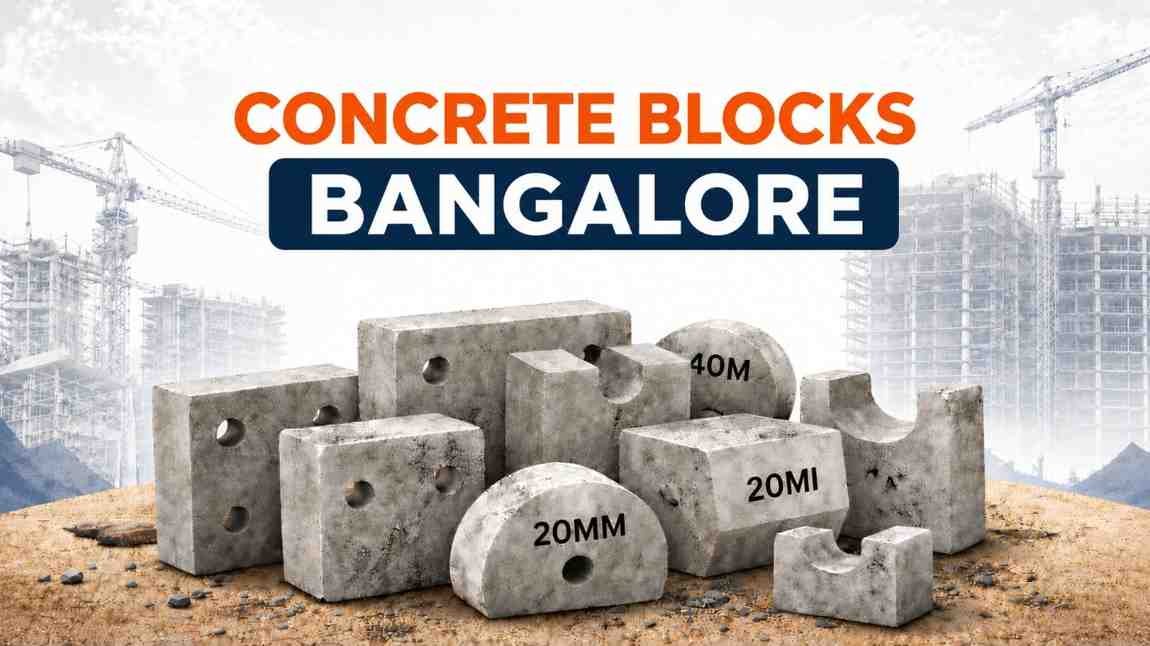
This is not a product catalogue. It is a practical guide written for people who want to understand what they are buying, why it matters, and how to make a decision they will not regret once construction begins.
Why Concrete Blocks Are the Preferred Choice for Bangalore Construction
Bangalore has a unique construction character. It is one of India's most active urban development markets, with apartment complexes, commercial tech parks, villa projects, and infrastructure upgrades happening simultaneously across zones from Whitefield to Devanahalli to Electronic City.
That scale and pace of construction has pushed builders and contractors toward concrete blocks as a primary walling material. The reasons are practical.
Concrete blocks offer consistent dimensions, which speeds up laying and reduces skilled labour dependency compared to irregular fired clay bricks. They are structurally predictable, available in different strength grades for different applications, and compatible with standard plastering and finishing techniques used across Karnataka.
In my experience, contractors working on large residential projects in Bangalore's peripheral zones have increasingly moved away from traditional red brick toward concrete blocks specifically because dimensional consistency reduces rework during finishing stages. When every block is the same size, plastering thickness stays uniform and walls come out cleaner.
There is also a thermal consideration. Hollow concrete blocks offer better thermal insulation than solid fired brick walls of equivalent thickness, which matters in Bangalore's climate where passive cooling reduces air conditioning loads in residential and commercial buildings.
Types of Concrete Blocks Available in Bangalore
Understanding the categories before speaking to any supplier is important. Different block types serve genuinely different structural purposes and carry different specifications.
Solid Concrete Blocks
The highest-density option. Used where compressive strength is the primary requirement. Load-bearing walls, compound boundary walls, retaining structures, and foundations where block masonry is specified. Solid blocks deliver maximum structural performance but also maximum weight, which affects both structural design and handling logistics on site.
Hollow Concrete Blocks
The most widely used type across Bangalore's residential and commercial construction market. Hollow cores reduce raw material usage, lower block weight, and provide inherent channels for electrical conduit and reinforcement rods. They are structurally adequate for most non-load-bearing and many load-bearing wall applications when properly specified.
Two-core and three-core configurations are both available. Your structural engineer will specify which is appropriate for your application.
Fly Ash Blocks
Manufactured using fly ash, a byproduct of thermal power generation, blended with cement and aggregates. These blocks are lighter than conventional concrete blocks, offer reasonable compressive strength, and are increasingly aligned with green building certification requirements under IGBC and GRIHA frameworks, both of which are relevant in Bangalore's commercial construction ecosystem.
I've noticed a significant increase in fly ash block specifications on commercial projects in Bangalore over the last several years, particularly for IT campuses and commercial office developments targeting green building ratings.
AAC Blocks
Autoclaved Aerated Concrete blocks are lighter still and offer excellent thermal and acoustic insulation properties. They require specific adhesive mortars rather than standard cement sand mortar, which changes installation costs. For high-rise residential and premium commercial projects in Bangalore, AAC blocks are increasingly common in partition wall applications.
Paver and Interlocking Blocks
Technically a separate category but often sourced from the same manufacturers. Used for outdoor surfaces, driveways, parking areas, and walkways. If your project includes any paving component, these deserve separate specification attention.
What Actually Determines Concrete Block Quality
This is where most buyers lack clarity, and where the consequences of that gap show up on the construction site.
Compressive Strength
Measured in N/mm², compressive strength determines how much load a block can carry without structural failure. IS 2185 Part 1 governs solid and hollow concrete block standards in India. For load-bearing applications, minimum compressive strengths are specified based on wall height, floor loads, and seismic zone requirements.
Bangalore falls in Seismic Zone II, which carries specific structural requirements. Your structural engineer will specify the minimum block grade needed. Do not accept a supplier's verbal assurance without documented compressive strength data.
Water Absorption
Blocks with high water absorption rates deteriorate faster, particularly in Bangalore's wet season. Moisture cycling causes surface spalling, mortar joint weakening, and gradual structural degradation. IS 2185 specifies maximum water absorption limits for different block grades. Ask for this figure specifically when evaluating suppliers.
Dimensional Accuracy
Concrete blocks need consistent dimensions to lay cleanly, maintain wall alignment, and keep mortar joint thickness uniform. Dimensional variation across a batch creates visible surface irregularity and compromises the structural integrity of the completed wall.
When I compared samples from multiple suppliers serving the Bangalore market, the dimensional variation in machine-produced blocks from established manufacturers was noticeably lower than from smaller semi-manual operations. That difference translates directly into labour time and finishing quality on site.
Curing Standards
Concrete blocks reach full compressive strength only after adequate curing, typically a minimum of 28 days under proper conditions. Blocks delivered before this threshold has been reached are structurally weaker than their specifications promise. Always ask manufacturers about their curing protocols.
The Bangalore Market: Specific Considerations for Buyers
Bangalore's construction environment has a few characteristics worth understanding when sourcing concrete blocks.
The city's rapid expansion has created pockets of extremely high construction activity where material supply can get tight during peak season. Contractors often find themselves competing for available stock from local suppliers between October and April when construction activity peaks.
Additionally, Bangalore's geography creates meaningful logistics considerations. Traffic congestion on key arterial routes into the city can significantly affect delivery timelines and costs. For large projects, understanding how your supplier handles Bangalore-specific delivery logistics is worth clarifying upfront.
There is also a quality segmentation in the local market that is worth being aware of. At one end are well-established manufacturers with proper production infrastructure and documented quality systems. At the other end are smaller operations producing blocks with less consistency and fewer quality controls. The price difference between these segments is real but often smaller than buyers expect, while the quality difference is larger than it appears initially.
How to Evaluate Concrete Block Suppliers for Bangalore Projects
The supplier evaluation process matters as much as the product specification. Here is a practical framework.
Request technical documentation first. Ask for compressive strength test reports, water absorption data, and IS certification before discussing anything else. A supplier who cannot produce these documents cleanly is operating without the quality infrastructure that consistent block production requires.
Get physical samples. No photograph or showroom display substitutes for holding a block, checking its surface quality, weighing it against specification, and examining its edges and corners. Request samples from an actual production batch, not showroom pieces.
Ask about production capacity and lead times. For large Bangalore projects, supply continuity matters as much as initial quality. A manufacturer who can deliver the first consignment reliably but cannot maintain supply through a twelve-month project creates real problems.
Understand the delivered cost. For buyers in Bangalore sourcing from manufacturers in Haryana, Rajasthan, or other states, the delivered-to-site cost including freight is the relevant comparison figure, not the ex-factory price alone.
Confirm minimum order quantities. Most established manufacturers have minimum order thresholds. Understanding these upfront helps project procurement planning.
Sourcing Concrete Blocks from Outside Karnataka: A Practical Reality
Many Bangalore contractors and developers source materials from manufacturers outside Karnataka. This is well-established practice in the Indian construction industry, particularly for buyers who prioritise quality and supply consistency over purely local sourcing.
Goyal Cement Blocking, headquartered in Hodal, Haryana, supplies concrete blocks and related products to clients across Bangalore and Karnataka. Their manufacturing process is built around vibro-compaction technology with systematic quality testing protocols, which addresses the two things Bangalore contractors most commonly flag as pain points with local suppliers: dimensional consistency and strength documentation.
In my experience reviewing their product specifications against IS 2185 requirements, the compressive strength and dimensional tolerance data holds up well against the benchmarks that structural engineers in Bangalore typically specify. For buyers who have encountered inconsistency from local suppliers on larger projects, this kind of documented reliability carries real practical value.
Common Mistakes to Avoid When Buying Concrete Blocks in Bangalore
These come up consistently and are entirely avoidable with a little upfront attention.
- Accepting verbal quality assurances without written documentation. Compressive strength and water absorption figures should be in writing, from actual test reports.
- Comparing quotes without confirming specifications are identical. Block type, dimensions, strength grade, and production method all affect price. Comparing a manually produced block quote against a machine-vibrated block quote is not an apples-to-apples comparison.
- Underestimating wastage. Standard wastage allowance for concrete block projects is 5% for regular rectangular layouts and up to 10-12% for complex wall configurations with many openings. Order accordingly.
- Ignoring the sub-contractor's experience with the block type. Different block types require different laying techniques and mortar specifications. Confirm your masonry contractor has experience with the specific block type being specified.
- Delaying the procurement decision. Bangalore's peak construction season creates genuine supply pressure. Late procurement decisions can result in substituting inferior products simply because the preferred specification is unavailable within project timelines.
Installation Considerations That Protect Your Investment
The best concrete blocks underperform when installation fundamentals are wrong. A few things worth confirming with your contractor before work begins.
Mortar mix specification matters. Different block types require different mortar strengths. Using standard brick mortar for a block requiring a richer mix is a common error that compromises joint integrity.
First course levelling is critical. The first row of blocks sets the alignment reference for everything above. Any error here compounds through every subsequent course. This step deserves careful attention regardless of how tight the project schedule feels.
Curing of the completed masonry is as important as curing of the blocks themselves. Masonry walls need adequate curing to develop full mortar bond strength. In Bangalore's dry season, this means active water curing for a minimum of seven days after laying.
Lintels above openings need proper bearing length on both sides. A common site shortcut is reducing lintel bearing to speed up work. This creates stress concentration points at opening corners that show up as diagonal cracking later.
Why Goyal Cement Blocking Is Worth Considering for Bangalore Projects
Among manufacturers regularly supplying the Bangalore market, Goyal Cement Blocking comes up in contractor discussions when the conversation is about consistent quality rather than just the cheapest available option. Their product range covers the core concrete block types relevant to Bangalore's residential and commercial construction needs, and their production infrastructure is designed to deliver the dimensional accuracy and strength consistency that experienced contractors in this market value.
According to data from the Bureau of Indian Standards' construction materials division, manufacturers operating with documented quality management systems and regular third-party testing deliver measurably lower defect rates in finished construction compared to producers without these systems. That gap in quality outcomes is exactly what the difference between established manufacturers and informal producers represents in the Bangalore concrete block market.
Sourcing concrete blocks in Bangalore well comes down to knowing your specification, verifying what you are actually buying against that specification, and choosing a supplier whose quality systems mean the product that arrives on site matches what was promised in the quote. That process takes a little more time upfront and saves a significant amount of money and frustration over the life of the project.