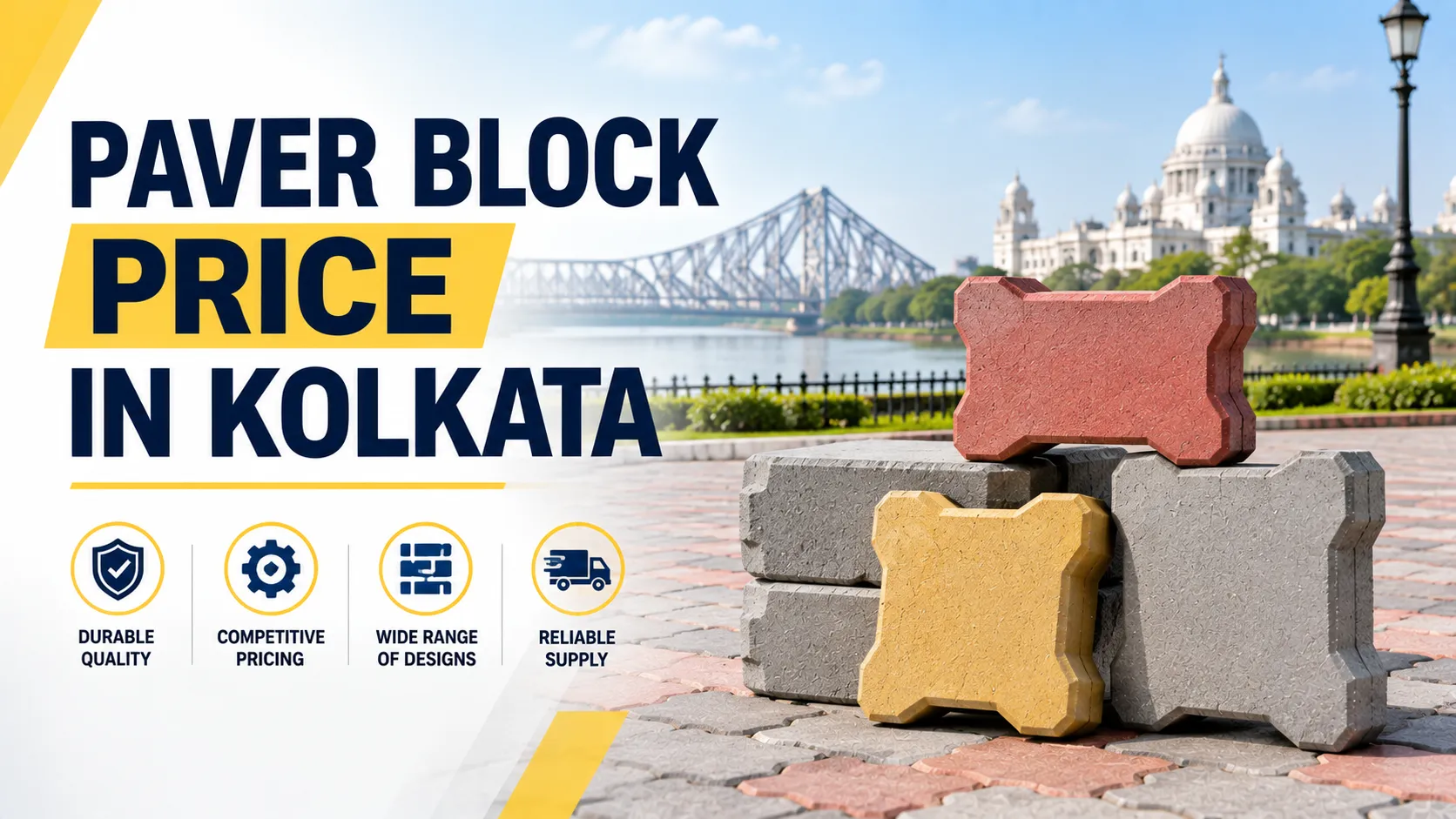
When it comes to figuring out price on paver blocks in Kolkata, knowing what the numbers are is not as helpful as knowing how they are impacted. Understanding how the numbers are impacted enables the customer to make an intelligent decision on whether it is worth buying at that price, and how to discern between fair and respectable quotes and quotes that may exploit atypical customer knowledge.
For each of these factors, this page will outline how to prepare to make an informed request of a supplier for a quote.
What Paver Blocks “Really” Cost
Paver block quotes rarely have a single, flat cost. When manufacturers and suppliers construct a quote, they consider multiple factors. A block's cost can vary due to:
- Block design (including plain, zig zag, interlocking, colored blocks)
- Thickness, 60mm and 80mm blocks cannot be substituted for each other
- Quantity ordered; bulk purchases are priced differently than smaller purchases
- Finish (plain gray or pigmented)
- Distance to deliver and how accessible your worksite is to and from Kolkata
Two different customers looking for “paver blocks” can end up looking for entirely different things when thickness and design factors are added into the equation. For this reason, when you actually call suppliers, the same search for “paver block price in Kolkata” can yield a very wide range of costs.
Factors That Move the Price Needle
Thickness and Load Requirement
This is usually the biggest variable. A block meant for a pedestrian pathway does not need to be as thick as a block going under a delivery truck's tyres. Lighter foot traffic areas use thinner blocks while driveways, parking areas and industrial yards need thicker, higher compressive strength blocks. Thinking in terms of actual use case and not guesswork, when it comes to thickness is the key decision point even before comparing quotes.
Type of Paver Block
An interlocking paver block, a zig zag paver block and a plain rectangular paver block are not manufactured the same way and serve different purposes. Interlocking designs are better at distributing load and are resistant to lateral movement under vehicle traffic making them ideal for driveways and parking areas. Simpler rectangular or square designs are often seen in walkways and courtyards where visual appeal trumps heavy load distribution.
Colour and Surface Finish
A plain grey cement paver block generally involves a simpler production process than a pigmented one. Coloured or textured paver blocks involve consistent pigment mixing across a batch and getting that consistent look across the entire batch such that there is no visible variation between blocks once laid, requires a more technically proficient process than producing a standard grey block.
Order Quantity
Small quantities for a home driveway and bulk quantities for a commercial or industrial project are handled very differently by most manufacturers, both when it comes to production planning and logistics. And if you're sourcing for a larger project, it's well worth having a discussion around your full requirement before placing smaller orders, since both production scheduling and delivery planning benefit from having a clear picture of the total quantity in hand.
Transport and Site Access
Kolkata's traffic patterns and site accessibility, especially in older or narrower parts of the city, can impact on how straightforward delivery actually is. A site with easy truck access is simpler to supply than one requiring multiple smaller trips or manual unloading over a distance. This aspect of supply is often overlooked by buyers comparing quotes, but it is a real consideration for suppliers.
Interlocking Paver Block vs Plain Paver Block: Comparing the Difference Essay
When choosing between interlocking and plain paver blocks, the decision usually depends on the location:
The former holds under pressure better, being designed to interlock under traffic and resist shifting, making it ideal for driveways, parking lots, and industrial parks. The latter is usually made in rectangular or square shapes that allow for a neater pattern and are used for sidewalks, footpaths, and courtyards.
Thus, neither of the two options is better than the other; everything depends on the conditions of use and the equipment that will be allowed on the surface.
Where Kolkata's Market Conditions Matter
The mix of established residential neighbourhoods, emerging commercial corridors and infrastructure projects around the metro and suburban rail network means Kolkata's paver block demand comes from very different kinds of buyers, homeowners renovating a driveway, contractors working on commercial sites and developers managing larger residential complexes.
In my experience, buyers who search generically for "paver blocks near me" without first figuring out thickness and load requirement tend to end up comparing quotes that aren't for the same product. It's worth doing that groundwork, because a quote for a 50mm plain block and a quote for an 80mm interlocking block will naturally look very different, and comparing them side by side without understanding why is where a lot of confusion starts.
Common Mistakes Buyers Make When Evaluating Quotes
Some people make apples-to-oranges comparisons when evaluating quotes. If Supplier A quotes on 50mm Blocks, and Supplier B quotes on 60mm Blocks, you need to be careful before saying that they are quoting apples to apples (even though they are both quoting on paver blocks).
Skipping the question on compressive strength. The specification IS 15658 specifies the performance characteristics of paver blocks and compressive strength is one of the first things you must ask about. If the supplier is unable to answer this question, then it is better to ask multiple other questions, rather than accept no answer.
Not accounting for wastage and cutting. You must account for additional materials to account for cutting required along the edges and to meet the requirements of an irregular shaped installation. Buyers often discover that they are short on material if they order precisely to the calculated square feet.
Neglecting curing time. Most paver blocks state that a minimum curing time of 28 days is required in order for the blocks to attain their design strength. Blocks that are rushed to the construction site, before properly curing, tend to under perform and do not meet the expectations set by the block's purchasing price.
Assuming that all paver block designs that are described as “interlocking” are equal. The term is used rather liberally. You need to specifically confirm the interlocking pattern offered and if it is suitable for the traffic to be anticipated.
Questions to Ask Before Ordering
When dealing with any of the paver block manufacturers listed with your search results or any contact supplier, consider the following:
- Will my application require special thickness? (footpace, driveway, parking, yard)
- What is your rated IS 15658 Compression value?
- With Kolkata's monsoon season, and the customers located in that region, what is your water absorption rate?
- How much lead time will you need to supply the quantity I need?
- Are shipping costs built into your quote, or will I need to account for that also?
- What will be the consistency of dimensions across multiple batches?
- Do you offer a custom design, but if you do, what is the minimum order quantity?
Requests for quotes in this manner, rather than asking, "What are your paver block prices?" almost always results in more relevant quotes.
Getting an Accurate, Comparable Quote
The best way to get an accurate quote for paver blocks in Kolkata is to have a discussion about the specifics of the job, and then worry about the quote. Once you and the supplier have agreed on the thickness, type, the number needed, and the finish, then the supplier can give you a number that represents the cost of the blocks, as opposed to a preliminary estimate that will probably change.
Goyal Cement Blocking, located in Hodal, Haryana, provides paver blocks and interlocking tiles to customers in Kolkata and other cities, and also uses the specification-first process to work out the details of the job before providing a quote. If you are interested in other products, the websites Paver Block Suppliers in Kolkata and Paver Block Manufacturer in Kolkata contain information about sourcing and manufacturers that are useful along with this site.
No matter which supplier you select, the first discussion should be for information only. Being specific about the thickness, the strength of the blocks, and the finish will result in a much better quote than a random number over the phone.