Whether you are constructing a boundary wall, retaining structure, landscape feature, or building partition, interlocking systems offer a practical solution that combines strength with efficiency. The right wall system can save time during construction while delivering excellent long-term performance.
At Goyal Cement Blocking, we have seen increasing demand for interlocking solutions because builders and property owners appreciate their durability, simplicity, and versatility.
What Are Interlocking Wall Blocks?
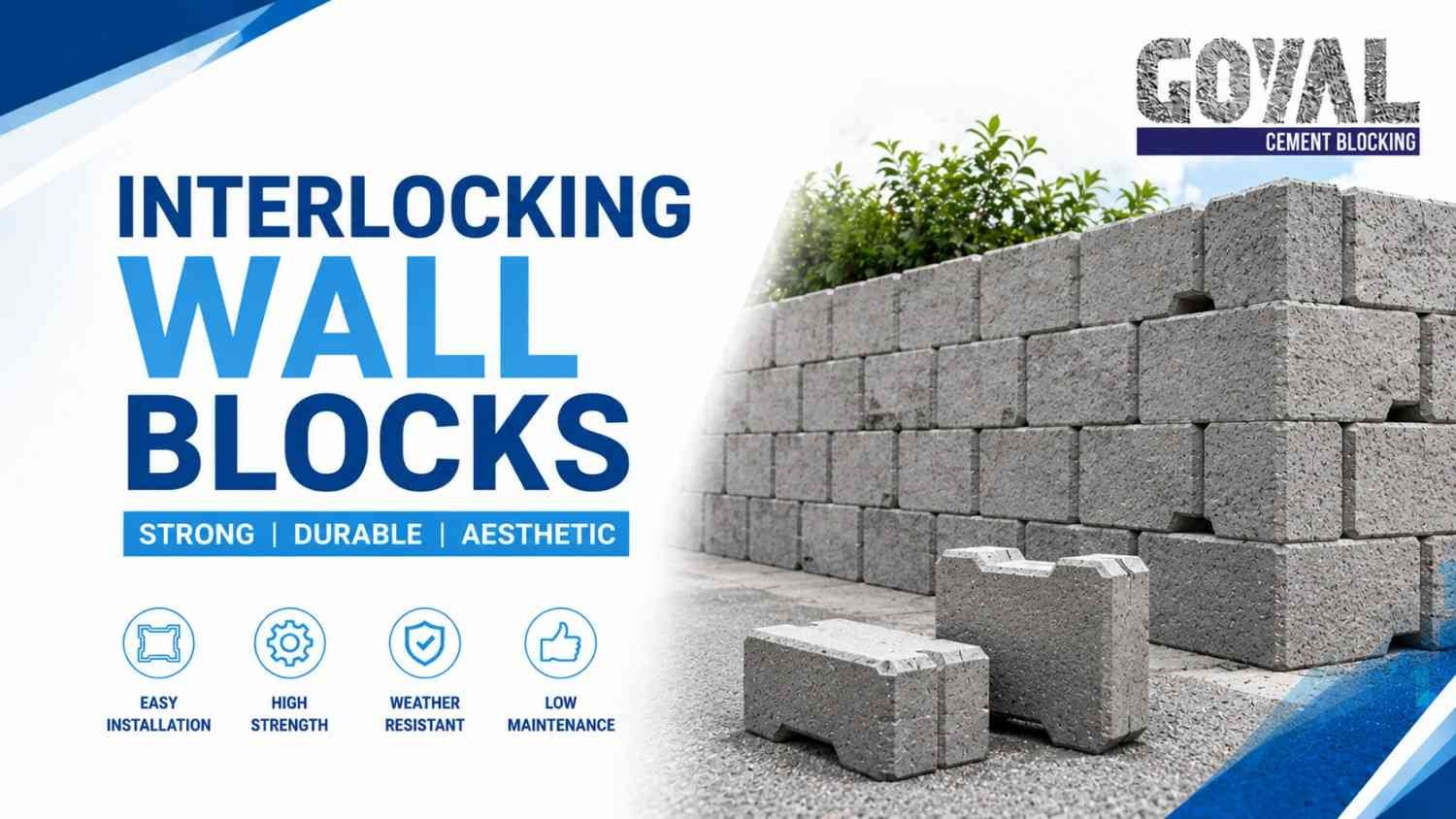
Interlocking wall blocks are specially engineered concrete blocks designed to fit together through a mechanical locking system. Unlike conventional bricks that rely heavily on mortar, these blocks connect securely with one another, creating a stable and cohesive structure.
Imagine assembling pieces of a puzzle. Each block is manufactured with precision so that it locks into place with surrounding units. This creates a wall that distributes loads efficiently and maintains structural integrity.
The interlocking mechanism simplifies installation and contributes to overall wall strength.
Why Interlocking Wall Blocks Are Gaining Popularity
Construction methods continue to evolve, and efficiency has become a major priority.
Builders are increasingly choosing interlocking wall systems because they offer several practical advantages.
Some key benefits include:
- Faster construction
- Improved structural stability
- Reduced material waste
- Lower maintenance requirements
- Consistent quality
- Long service life
- Attractive appearance
When I tried evaluating different wall construction methods for a site development project, interlocking systems stood out because of how quickly the wall sections could be completed without sacrificing quality.
Benefits of Interlocking Wall Blocks
Exceptional Structural Strength
One of the biggest advantages of interlocking wall blocks is their ability to create strong and stable structures.
The locking mechanism allows loads to be distributed across multiple units, helping improve overall wall performance.
Faster Installation
Time is valuable on every construction project.
Because the blocks are designed to fit together accurately, installation often requires less effort than traditional masonry systems.
Enhanced Durability
Concrete interlocking blocks are designed to withstand environmental exposure, moisture, temperature changes, and daily wear.
Consistent Construction Quality
Precision manufacturing helps ensure that every block maintains uniform dimensions.
This consistency contributes to better alignment and a more professional finished appearance.
Cost-Effective Maintenance
I've noticed that properly installed interlocking walls generally require less maintenance compared to some traditional construction methods.
That can be a significant advantage over the life of a structure.
Common Applications of Interlocking Wall Blocks
Boundary Walls
Property owners frequently use interlocking wall blocks to create durable and secure perimeter walls.
Retaining Walls
Interlocking systems are commonly used for retaining applications because of their strength and stability.
Residential Construction
Homeowners often choose interlocking blocks for:
- Compound walls
- Garden boundaries
- Decorative features
- Utility structures
Commercial Developments
Office complexes, shopping centers, and commercial facilities benefit from efficient wall construction methods.
Industrial Facilities
Industrial sites frequently require robust wall systems capable of withstanding demanding conditions.
How Interlocking Wall Blocks Work
The effectiveness of interlocking systems comes from their design.
Mechanical Interlock
Each block contains specially designed features that connect securely with adjacent blocks.
Load Distribution
Instead of acting independently, the blocks function as a unified system.
Improved Stability
The interlocking arrangement helps reduce movement and contributes to wall integrity.
Construction Efficiency
The design minimizes alignment challenges and speeds up installation.
Types of Interlocking Wall Blocks
Different projects require different wall systems.
Solid Interlocking Blocks
These blocks provide excellent strength and are suitable for heavy-duty applications.
Hollow Interlocking Blocks
Hollow units reduce overall weight while maintaining structural performance.
Decorative Wall Blocks
Decorative options combine functionality with visual appeal.
Retaining Wall Blocks
These blocks are specifically designed to resist soil pressure and maintain stability.
Modular Wall Blocks
Modular systems provide flexibility for projects of varying sizes and configurations.
Why Durability Matters
Walls are expected to perform for decades.
Environmental exposure, temperature changes, moisture, and physical loads all influence long-term performance.
According to research published by the International Journal of Civil Engineering and Technology, properly manufactured concrete block systems demonstrate excellent durability and long service life when installed according to engineering standards.
This highlights the importance of selecting quality materials from trusted manufacturers.
In my experience, the durability of a wall often depends as much on material quality as it does on construction technique.
Choosing the Right Interlocking Wall Blocks
Selecting the right blocks requires careful consideration.
Understand Project Requirements
Different applications require different performance characteristics.
A garden wall has different needs than an industrial boundary wall.
Evaluate Structural Demands
Consider:
- Wall height
- Load requirements
- Environmental conditions
- Site characteristics
Assess Manufacturing Quality
Look for:
- Consistent dimensions
- Smooth finishes
- Uniform density
- High compressive strength
Work with Reliable Manufacturers
Choosing a trusted supplier helps ensure product consistency and dependable performance.
Many builders rely on manufacturers such as Goyal Cement Blocking because quality control plays a crucial role in successful construction projects.
Installation Process
Proper installation helps maximize the performance of interlocking wall blocks.
Step 1: Site Preparation
The construction area is cleared and prepared according to project requirements.
Step 2: Foundation Construction
A stable foundation supports the entire wall structure.
Step 3: First Course Placement
The first row is carefully aligned to establish the wall's accuracy.
Step 4: Interlocking Installation
Additional blocks are placed and locked into position.
Step 5: Alignment Verification
Regular checks ensure structural consistency throughout construction.
Step 6: Final Finishing
Any required finishing work is completed after installation.
Environmental Benefits of Interlocking Wall Blocks
Sustainability is becoming increasingly important in construction.
Interlocking systems support environmentally responsible practices through:
- Reduced material waste
- Efficient use of resources
- Long service life
- Lower maintenance requirements
These factors contribute to more sustainable construction outcomes.
Comparing Interlocking Wall Blocks with Traditional Brickwork
| Feature | Interlocking Wall Blocks | Traditional Bricks |
|---|---|---|
| Installation Speed | Faster | Slower |
| Structural Stability | Excellent | Good |
| Material Waste | Lower | Higher |
| Alignment Accuracy | High | Moderate |
| Maintenance | Lower | Moderate |
| Durability | High | High |
For many projects, these advantages make interlocking wall systems an attractive option.
Why Contractors Prefer Interlocking Wall Systems
Contractors are often focused on reliability, efficiency, and performance.
Interlocking wall blocks offer:
- Simplified construction
- Consistent results
- Excellent durability
- Reduced labor requirements
- Versatile applications
When I visited a commercial construction site using interlocking wall blocks, the project manager highlighted how much time had been saved compared to conventional masonry methods.
Those practical benefits continue to drive demand for interlocking systems.
Future of Interlocking Wall Construction
The construction industry continues to embrace solutions that improve efficiency and durability.
Interlocking wall blocks align with modern construction goals by offering:
- Faster project completion
- Improved structural performance
- Sustainable construction practices
- Long-term reliability
As technology advances and building requirements evolve, interlocking systems are expected to play an even greater role in construction projects of all sizes.