That component is the cover block. Understanding the factors that influence concrete cover block price can help you make better construction decisions without compromising quality.
Many builders discover this only after facing issues such as reinforcement exposure, corrosion, or reduced structural lifespan. Choosing the right cover block from the beginning helps prevent these problems and supports long-term structural performance.
At Goyal Cement Blocking, we often speak with contractors and project managers who initially underestimated the importance of cover blocks. Once they understand their role in reinforced concrete structures, they quickly realize that quality matters just as much as quantity.
Understanding Concrete Cover Blocks
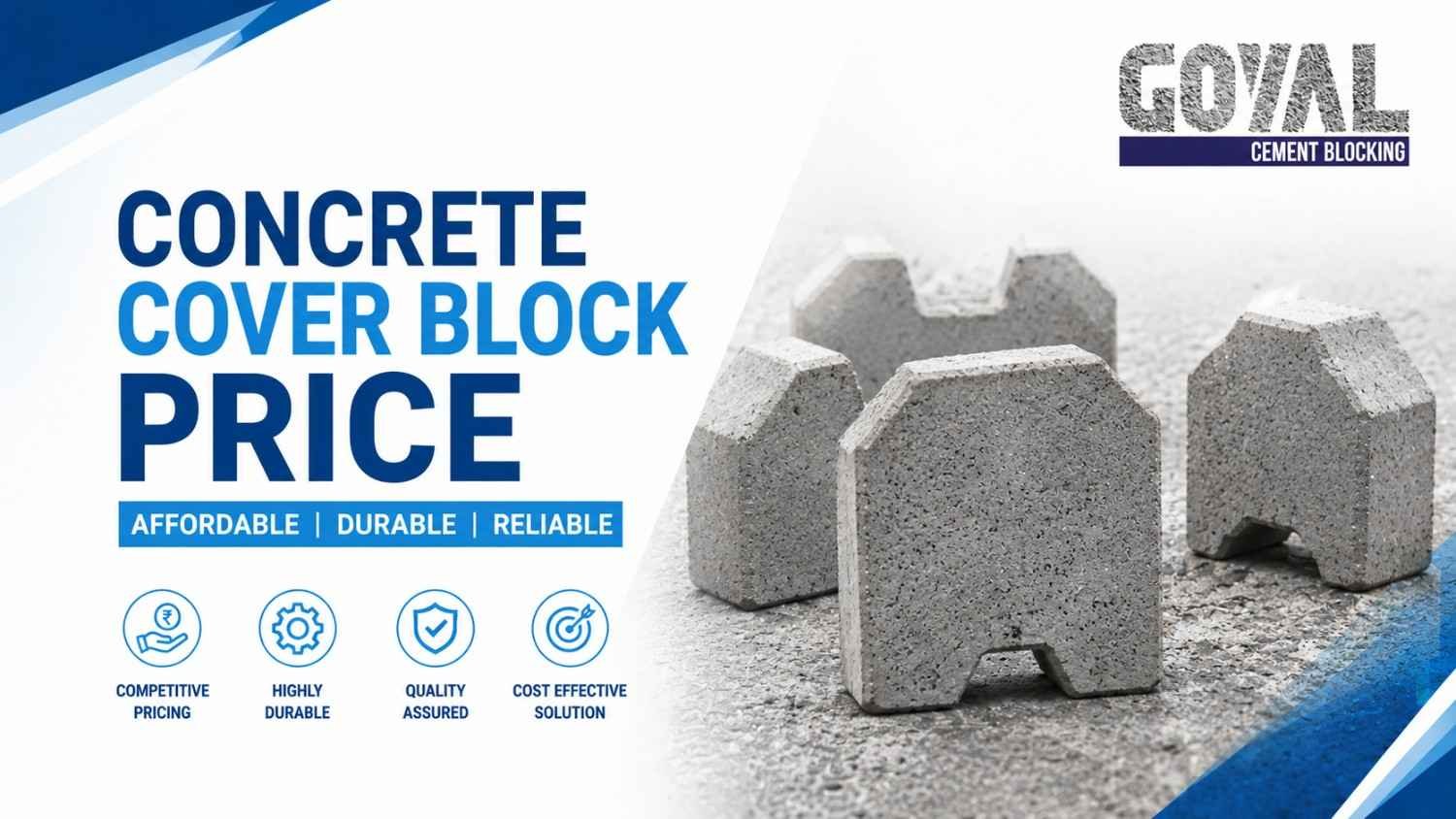
Concrete cover blocks are small precast concrete components used to maintain the required distance between reinforcement bars and the outer surface of concrete.
Their purpose may seem simple, but they perform a critical function. They ensure that steel reinforcement remains properly embedded within concrete, protecting it from moisture, chemicals, and environmental exposure.
Without adequate concrete cover, reinforcement bars can corrode over time, weakening the entire structure.
Why Cover Blocks Matter
Cover blocks help achieve:
- Proper reinforcement positioning
- Improved structural durability
- Enhanced load-bearing performance
- Protection against corrosion
- Compliance with construction standards
- Better concrete placement and compaction
Think of a cover block as a protective buffer. It quietly does its job throughout the life of a structure.
Factors That Influence Concrete Cover Block Price
Many people search for information about concrete cover block price expecting a simple answer. In reality, several factors affect the selection and overall value of cover blocks.
Material Quality
The quality of concrete used in manufacturing plays a major role in performance.
High-strength concrete cover blocks generally provide:
- Better durability
- Greater load-bearing capacity
- Improved resistance to cracking
- Enhanced lifespan
In my experience, choosing premium-quality cover blocks often leads to better long-term project outcomes because they maintain their shape and strength during concrete placement.
Cover Block Size
Different construction elements require different cover thicknesses.
Common applications include:
- Slabs
- Beams
- Columns
- Footings
- Foundations
- Retaining structures
As size requirements increase, manufacturing specifications also change.
Manufacturing Precision
Dimensionally accurate cover blocks ensure uniform concrete cover throughout the structure.
Poorly manufactured blocks can lead to inconsistent reinforcement placement and reduced structural integrity.
I've noticed that experienced contractors always inspect dimensional consistency before approving materials for large projects.
Compressive Strength
Cover blocks must withstand the pressure exerted during reinforcement placement and concrete pouring.
Higher-strength products typically offer greater reliability under demanding site conditions.
Quantity Requirements
Large infrastructure projects often require thousands of cover blocks. Production scale and project volume can influence manufacturing and supply considerations.
Types of Concrete Cover Blocks Used in Construction
Different structural elements require different cover block designs.
Slab Cover Blocks
These are commonly used in floor slabs and roof slabs.
They help maintain uniform reinforcement spacing and support proper concrete coverage.
Beam Cover Blocks
Beam reinforcement requires accurate positioning to achieve designed structural performance.
Specialized cover blocks are often used to maintain the required clearance.
Column Cover Blocks
Columns carry significant loads and require precise reinforcement placement.
Cover blocks help ensure proper cover depth around vertical reinforcement.
Foundation Cover Blocks
Foundations remain exposed to soil moisture and environmental conditions for decades.
Proper concrete cover is essential to protect embedded steel from corrosion.
Circular Cover Blocks
These are frequently used for vertical reinforcement cages in columns and piles.
Their design allows secure placement around steel bars.
How Quality Affects Long-Term Performance
It is tempting to treat cover blocks as a minor construction accessory. However, structural engineers often view them differently.
According to a report published by the American Concrete Institute (ACI), insufficient concrete cover remains one of the leading causes of premature reinforcement corrosion in reinforced concrete structures.
This highlights an important point.
A cover block is not just a spacer. It is a critical component in the durability system of reinforced concrete.
When I visited a commercial project several years after completion, the engineer explained how proper reinforcement cover contributed significantly to the structure's condition. Despite environmental exposure, the concrete remained intact and the reinforcement stayed protected.
That is the value of using quality materials from the beginning.
Benefits of Using High-Quality Concrete Cover Blocks
Enhanced Structural Durability
Quality cover blocks help maintain the designed concrete cover throughout construction and throughout the life of the structure.
Better Reinforcement Protection
Steel reinforcement remains shielded from moisture and aggressive environmental conditions.
Improved Construction Accuracy
Uniform cover blocks promote consistent reinforcement placement.
Reduced Risk of Corrosion
Adequate concrete cover helps minimize corrosion-related deterioration.
Compliance with Engineering Standards
Proper cover contributes to meeting structural design and construction requirements.
Common Mistakes to Avoid
Choosing Based Only on Cost
Many buyers focus entirely on concrete cover block price while overlooking performance characteristics.
The lowest-cost option is not always the most suitable choice for structural applications.
Ignoring Strength Requirements
Cover blocks should have sufficient strength to withstand site conditions and construction loads.
Using Incorrect Sizes
Different structural components require different cover depths.
Using the wrong size can affect structural performance and durability.
Overlooking Manufacturing Quality
Cracked, chipped, or poorly finished cover blocks should not be used in structural concrete work.
How to Select the Right Concrete Cover Block
Choosing the right product becomes easier when you follow a systematic approach.
Step 1: Identify the Structural Element
Determine whether the block will be used for:
- Slabs
- Beams
- Columns
- Foundations
- Walls
Step 2: Verify Cover Requirements
Consult structural drawings and project specifications.
Step 3: Check Product Strength
Ensure the cover blocks can withstand handling and placement loads.
Step 4: Assess Manufacturing Quality
Look for:
- Uniform dimensions
- Smooth finish
- Crack-free surfaces
- Consistent density
Step 5: Work with a Reliable Manufacturer
Established manufacturers such as Goyal Cement Blocking focus on producing cover blocks that meet modern construction requirements and quality expectations.
Why Builders Trust Concrete Cover Blocks
Construction professionals understand that durability begins with attention to detail.
Large infrastructure projects, residential buildings, commercial developments, and industrial facilities all rely on proper reinforcement cover to achieve long service life.
Even though cover blocks represent a small portion of the overall construction system, their contribution is significant.
In my experience, the most successful projects are often those where every component, no matter how small, receives proper consideration.
Applications Across Different Construction Projects
Residential Buildings
Cover blocks are used in:
- House foundations
- Roof slabs
- Columns
- Staircases
Commercial Buildings
Commercial structures require consistent reinforcement cover throughout large structural systems.
Industrial Projects
Factories and warehouses often experience demanding environmental conditions, making reinforcement protection especially important.
Infrastructure Development
Bridges, retaining walls, drainage systems, and public infrastructure projects all benefit from properly installed cover blocks.
Why Choose Goyal Cement Blocking
Builders and contractors seek consistency, reliability, and product quality.
Goyal Cement Blocking has established itself as a trusted manufacturer by focusing on durable concrete products designed for modern construction requirements.
The company's commitment to quality manufacturing helps ensure that cover blocks maintain dimensional accuracy, structural strength, and long-term performance.
Whether the project involves residential construction, commercial development, or infrastructure work, selecting quality cover blocks contributes to stronger and more durable structures.