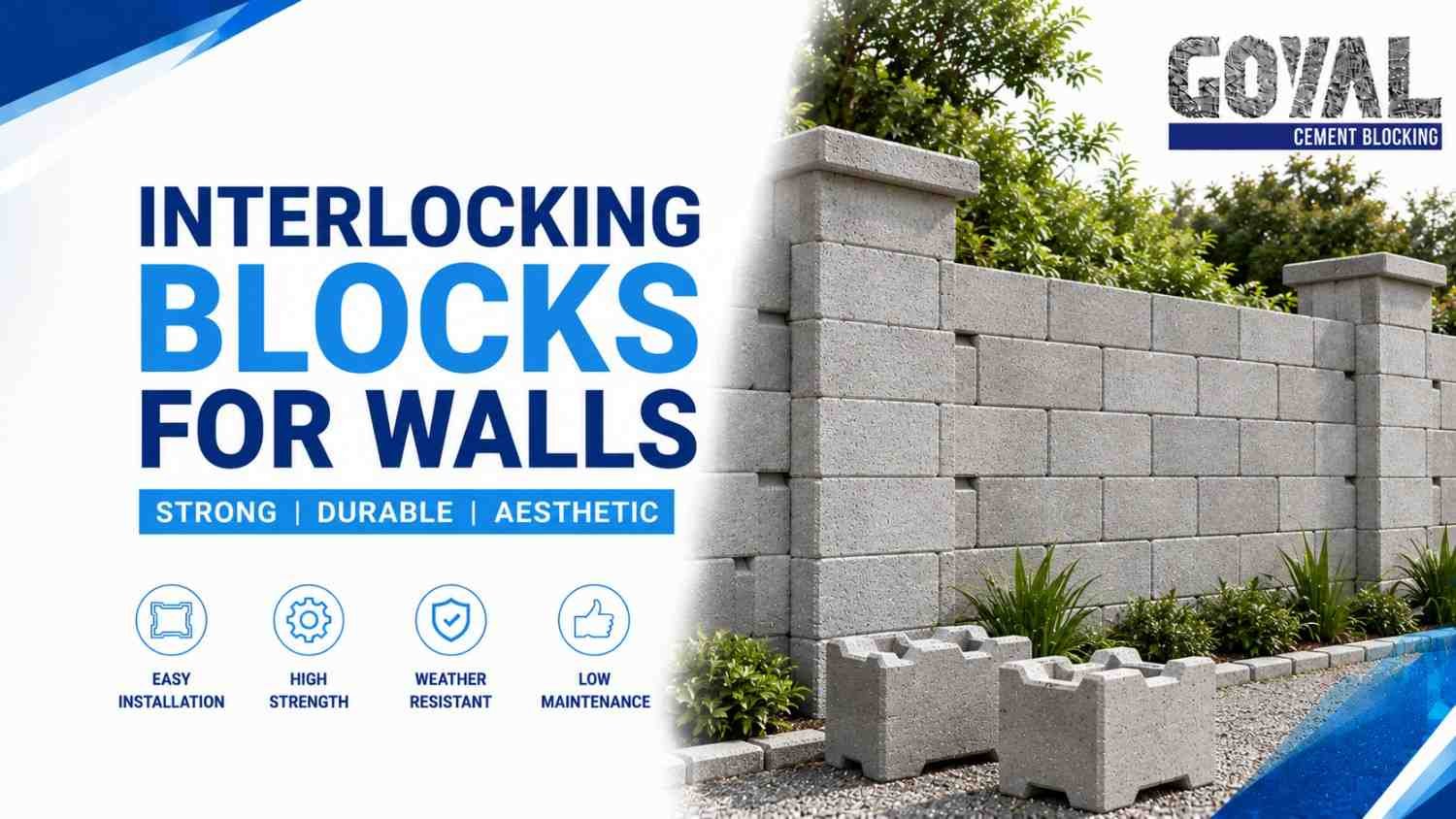
This guide walks you through everything — what these blocks actually are, the different types available, where they work best, and what to watch out for. No fluff, just the practical stuff.
What Are Interlocking Blocks for Walls?
Interlocking blocks are precast concrete or cement units designed with a specific geometry so each block connects directly to the next one. The connection happens through tongues, grooves, ridges, or interlocking profiles built into the block itself.
The result is a wall system where the blocks hold each other in position. You still need a solid base and, in many cases, some mortar between courses. But the interlocking design does a lot of the alignment work for you, which speeds things up and reduces the margin for error.
Think of it like this: building a wall with ordinary bricks is like stacking smooth stones and relying entirely on the mortar to hold them together. Interlocking blocks are more like puzzle pieces. The geometry itself contributes to the structure.
In my experience, this distinction matters enormously on larger projects. The more blocks you're placing, the more the interlocking system pays off in time and consistency.
Why Builders and Homeowners Are Switching to Interlocking Blocks for Walls
The shift is happening across India, quietly but steadily. Contractors who've worked with both conventional bricks and interlocking blocks tend to stick with interlocking once they've seen the difference on a real site.
There are a few reasons this is happening:
- Faster installation: The interlocking profile guides placement, so skilled workers can build walls faster than with traditional brickwork
- Less mortar dependency: Many systems need minimal mortar or none at all for certain applications, cutting material costs and mess
- Consistent alignment: Misaligned walls are one of the most common complaints on construction sites. Interlocking blocks make this much less likely
- Design flexibility: From plain boundary walls to decorative screen walls with patterned cutouts, the range is wide
- Durability: Well-manufactured cement interlocking blocks resist weathering, humidity, and thermal stress better than many alternatives
A study published by the Bureau of Indian Standards found that precast concrete masonry units produced under IS 2185 standards consistently outperform hand-mixed brick alternatives in compressive strength and dimensional consistency. That kind of reliability matters when you're building something meant to last decades.
Types of Interlocking Blocks for Walls
Not all interlocking blocks serve the same purpose. Choosing the wrong type for your application is one of the most common and costly mistakes you can make.
Solid Interlocking Blocks
These are fully solid blocks with interlocking profiles on the top and bottom faces. They're used where maximum strength is the priority: retaining walls, heavy boundary walls, and any application where the wall carries load or resists lateral pressure. No hollow sections, no decorative cutouts. Just strong, reliable masonry.
Hollow Interlocking Blocks
Hollow blocks have one or more vertical cavities running through them. This makes them lighter than solid blocks, improves thermal insulation, and allows for reinforcement bars and grout fill when structural reinforcement is needed. They're widely used in residential construction for partition walls and non-load-bearing boundary walls.
Decorative and Screen Blocks
This is where things get visually interesting. Decorative interlocking blocks feature geometric cutouts, lattice patterns, or perforated designs that allow light and air to pass through while still forming a continuous wall surface.
When I tried decorative screen blocks on a garden boundary wall for the first time, the client stood back and looked at it for a full minute before saying anything. The interplay of light and shadow through the pattern was genuinely striking in a way that no plain wall could replicate.
Ventilation Blocks
Specifically designed for airflow, these blocks have larger open sections. They're often used in utility areas, vehicle parking walls, and agricultural structures where constant air circulation is needed. They don't pretend to be decorative; they do one job and do it well.
Retaining Wall Blocks
These are heavier, often slightly tapered, and designed to stack in a battered (slightly inclined) configuration to hold back soil or create level changes in a landscape. The interlocking design here focuses on resisting outward pressure from the soil behind the wall.
Where Interlocking Blocks for Walls Work Best
The versatility here is real, not just marketing language. Let me walk through the most common applications.
Boundary and Compound Walls: This is the most common use across Indian residential and commercial projects. A well-built interlocking block boundary wall looks clean, ages well, and holds up to weather far better than plastered brick walls that tend to crack and stain over time.
Retaining Walls in Gardens and Landscapes: If your property has a slope or you're creating terraced garden beds, interlocking retaining wall blocks are the right tool. They manage soil pressure in a way that decorative blocks were never meant to.
Indoor Partitions: I've noticed this use is growing quickly, especially in open-plan homes and offices where people want division without destroying the sense of space. A screen block partition lets light through, defines zones, and becomes a genuine design feature.
Commercial Facades: Hotels, resorts, and office buildings use patterned interlocking blocks as exterior cladding to create distinctive appearances while managing solar heat gain. It's a practical and aesthetic decision at the same time.
Poolside and Terrace Walls: The combination of a well-chosen screen block pattern, good light, and water nearby creates something genuinely beautiful. The blocks cast different shadows at different times of day, which makes the space feel alive.
How to Choose the Right Interlocking Blocks for Your Wall
This is where most people need the most help. Here's a straightforward way to think about it:
Start with the function. Is the wall decorative, structural, or both? A garden screen wall and a retaining wall have completely different requirements, even if they look vaguely similar in a catalogue photo.
Check compressive strength. For any external or structural wall, you want blocks that meet IS 2185 standards. Ask your supplier for test certificates, not just verbal assurances.
Look at dimensional consistency. A batch of blocks with varying dimensions will cause alignment problems no matter how good your installation team is. Request a physical sample and measure it.
Consider the finish. Natural cement grey is popular and ages well. Some blocks come with textured or coloured finishes. Whatever you choose, make sure it's consistent across the entire order.
Think about maintenance. Some finishes require periodic sealing, especially for exterior applications. Factor this in before you decide.
Goyal Cement Blocking produces interlocking blocks across multiple pattern types and sizes, with consistent dimensional tolerances suited for both residential and large commercial projects. Their range covers everything from plain interlocking units to decorative screen designs, all manufactured to handle Indian weather conditions across the year.
Installation: What the Process Actually Looks Like
A lot of people imagine this being complicated. It's not, but it does require care at the foundation level.
Step 1 — Foundation preparation: The base must be level, properly compacted, and of adequate width for the wall you're building. This step cannot be rushed. Every problem I've seen with interlocking block walls traces back to a foundation issue.
Step 2 — First course placement: The first row sets the direction for everything above it. Take your time here. Use a spirit level at multiple points along the length.
Step 3 — Stacking subsequent courses: The interlocking profiles guide placement. Each block should seat firmly and squarely on the one below. Offset the vertical joints between courses for added stability.
Step 4 — Mortar application (if required): Some systems are dry-stacked. Others use a thin mortar bed. Follow the manufacturer's recommendation for your specific block type.
Step 5 — Finishing and capping: Cap the top course with a finishing block or a poured concrete beam. This protects the top of the wall from water ingress and gives a clean visual finish.
Mistakes That Are Easy to Avoid
Skipping the foundation check: No interlocking system compensates for an unlevel base. Spend the extra hour getting it right.
Mixing block batches carelessly: Dimensional variations between manufacturing batches can create visible lines or misalignment in long walls. Order enough blocks from the same batch for your entire project if possible.
Ignoring drainage behind retaining walls: Water pressure behind a retaining wall is one of the leading causes of wall failure. Build in proper drainage before you stack the first block.
Choosing by appearance alone: The most visually impressive block in the showroom might be completely wrong for your structural needs. Beauty and function need to align.